
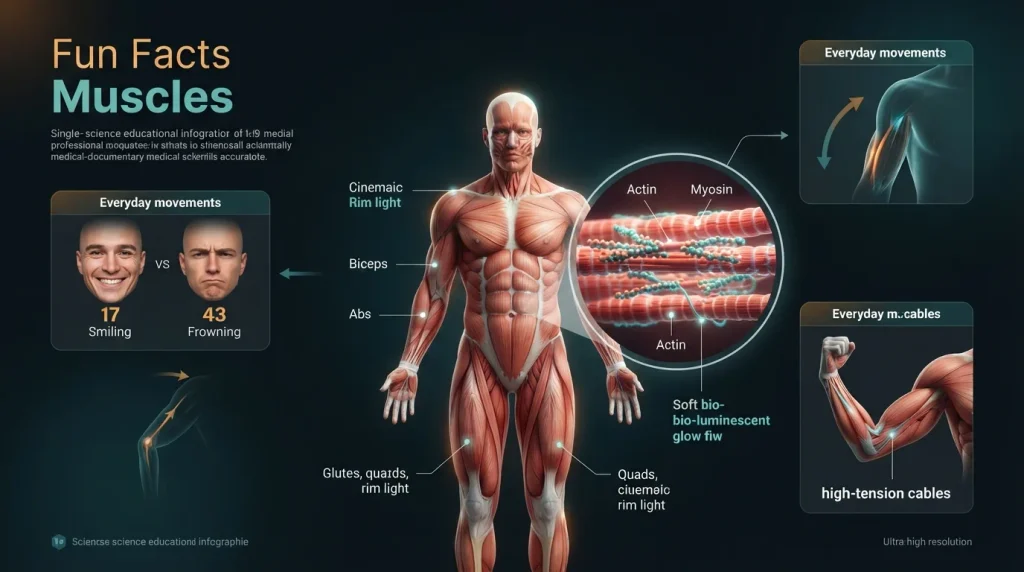
Your body relies on over 600 muscles to perform every movement, from blinking your eye to running a marathon. These powerful tissue fibers make up roughly 40% of your body weight. Understanding these fun facts muscles offer shows how your body generates heat, maintains balance, and stays strong.
Every single move you make relies on the incredible work of your muscular system. Learning fun facts muscles reveal helps you appreciate the hidden engine working under your skin.
Did you know your body operates more than 600 individual muscles just to keep you moving? Exploring these fun facts muscles share will completely change how you view your daily workouts and simple movements.
From your hard-working heart to the fast-blinking tissue in your eyes, your body is full of surprises. Let us take a friendly tour through the most fascinating muscle facts together.
The Secret Architecture of Your Muscular System
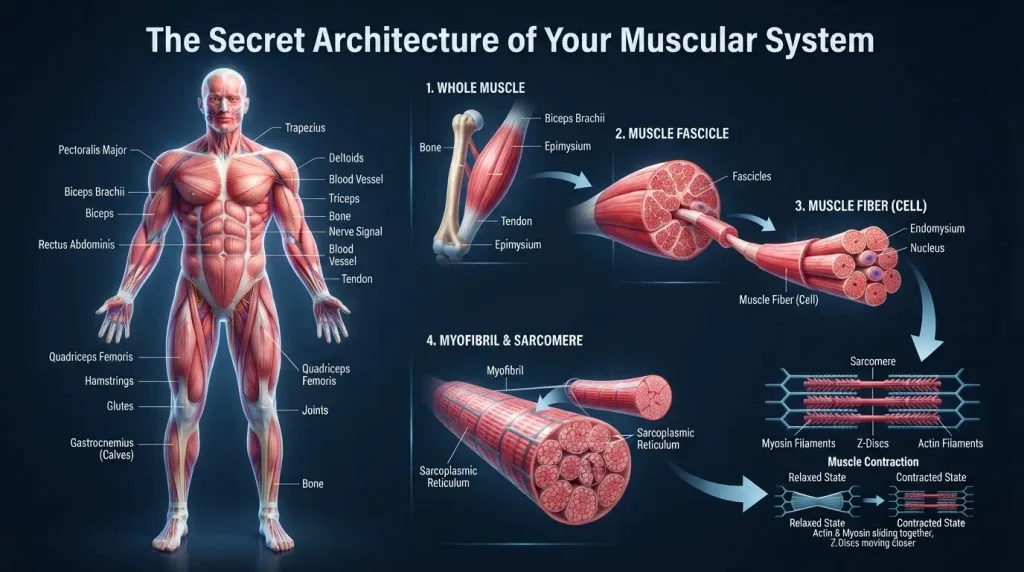
Your muscles do far more than just help you lift heavy boxes or do push-ups. They form a complex web of fibers that protects your organs and keeps your blood flowing smoothly every second.
The Three Core Types of Muscle Tissue
Your body contains three distinct categories of muscle tissue that handle completely different jobs. Smooth muscle operates inside your organs, moving food through your digestive system without you ever thinking about it.
Cardiac muscle makes up the thick walls of your heart, pumping blood day and night. Skeletal muscle connects directly to your bones, giving you full voluntary control over your arms, legs, and jaw.
How Muscle Fibers Generate Raw Power
Every muscle consists of thousands of tiny thread-like fibers bundled together tightly. When your brain sends an electrical signal, these tiny threads slide across each other to pull the muscle short.
This pulling action creates the force needed to turn a door handle, jump over a puddle, or smile at a friend. Because muscles can only pull and never push, they always work in balanced teams across your joints.
The Most Powerful, Largest, and Fastest Muscles
Not all muscles in your body are created equal. Some are built for endurance, while others deliver sudden bursts of speed or incredible physical strength.
The Strongest Muscle Based on Weight
The masseter muscle located in your jaw packs the biggest punch relative to its size. It works alongside your teeth to help you chew through tough foods with ease.
When all the muscles in your jaw work together, they can close your teeth with a force of over 200 pounds. That makes your jaw muscle an absolute powerhouse of efficiency.
The Largest Muscle in the Human Body
Your gluteus maximus holds the record as the single largest muscle in your whole frame. Located in your buttocks, this large muscle plays a vital role in keeping your torso upright.
It provides the main driving force when you climb steep stairs, run up hills, or stand up from a cozy chair. Without this big muscle, staying balanced while walking would be nearly impossible.
The Fastest Muscle in the Whole Body
The quickest-moving muscle in your entire body controls the movement of your eyelid. Known as the orbicularis oculi, this tiny muscle can snap shut in less than a hundredth of a second.
A single blink allows your eye to clean away dust and stay moist without interrupting your view of the world. In a single day, this fast little muscle twitches tens of thousands of times.
How Your Muscles Generate Heat and Burn Energy
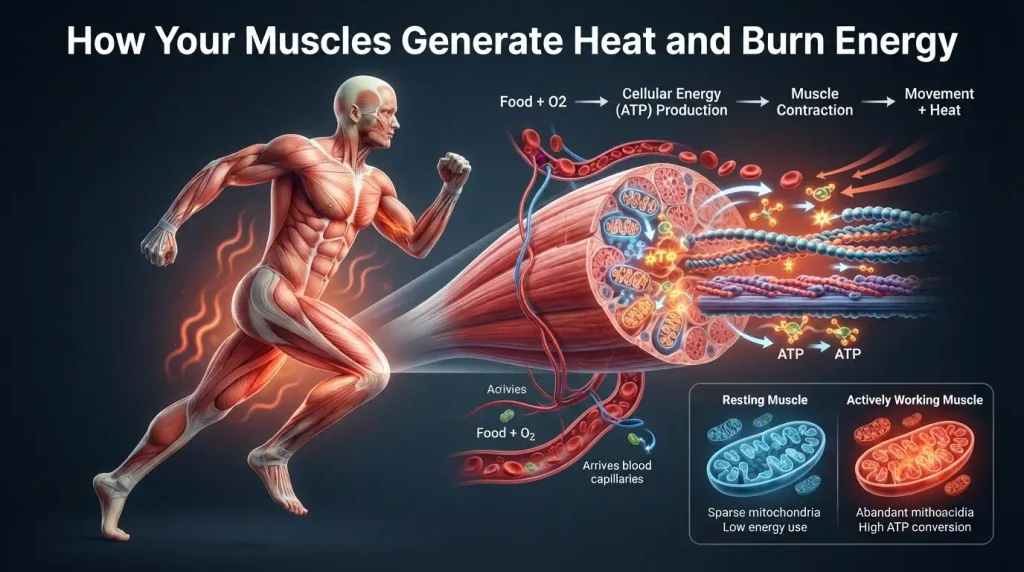
Your muscular system acts as your internal heating pad and primary energy user. Every time you move, your body converts fuel from your food into physical motion and warmth.
Why You Shiver When You Get Cold
When your core body temperature drops, your brain sends rapid panic signals to your skeletal muscles. These muscles quickly contract and relax in rapid succession, which we call shivering.
This fast shaking motion creates thermal energy as a byproduct of muscle work. That sudden heat boost helps protect your vital internal organs from chilling temperatures.
Muscles as Metabolic Engines
Muscle tissue burns energy even when you are resting peacefully on the couch. Having more lean muscle mass naturally raises your basal metabolic rate throughout the day.
This means your body uses up calories just maintaining healthy muscle cells. Building strength stays one of the most effective ways to support long-term metabolic health.
Incredible Comparison of Muscle Superpowers
Animals have developed remarkable muscle abilities to survive, hunt, escape, and move efficiently. While humans rely on strength, many animals outperform us in specific muscle-based skills. Comparing these abilities reveals how evolution has created specialized muscle “superpowers” suited to different environments.
Explosive Jumping Power
Kangaroos use powerful leg muscles and elastic tendons to make impressive leaps while conserving energy. Fleas take jumping even further relative to their body size, using specialized structures and muscles to launch themselves many times their own height.
Incredible Strength
Gorillas are famous for their exceptional upper-body strength, supported by powerful muscles adapted for climbing, pulling, and movement. Their strength-to-size advantage makes them one of the most impressive examples of muscular power among land mammals.
Speed and Acceleration
Cheetahs combine strong leg muscles, flexible spines, and lightweight bodies to achieve extraordinary acceleration and sprinting speed. Their muscles work together with their skeletal structure to produce rapid strides, helping them chase fast-moving prey.
The Hardest Working Muscle: Your Heart
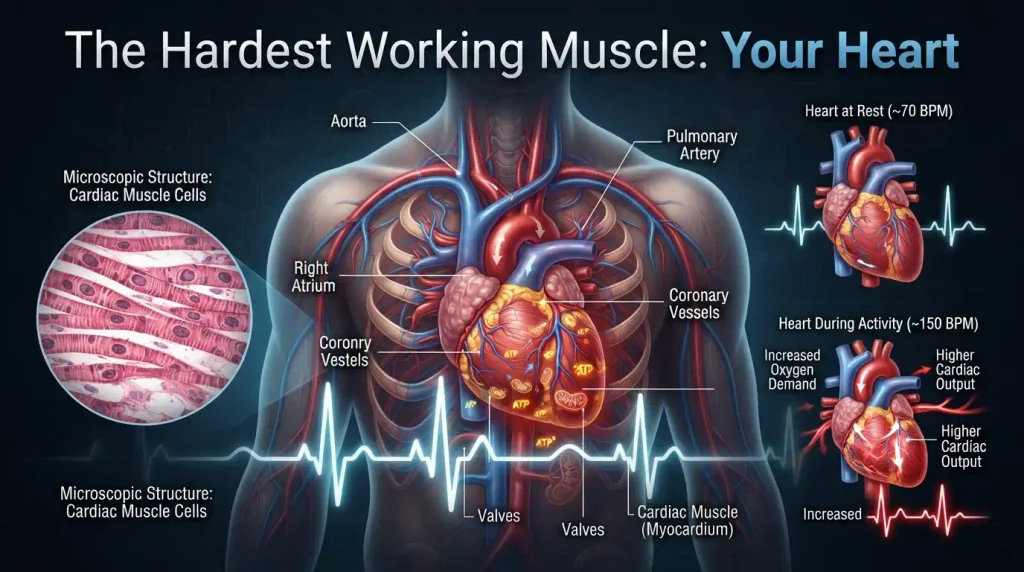
Your heart consists of specialized cardiac muscle tissue that works constantly without stopping. It operates without any voluntary direction from your conscious brain.
Non-Stop Pumping Day and Night
Your heart muscle pumps around 2,000 gallons of blood through your circulatory network every day. It contracts about 100,000 times in twenty-four hours to keep fresh oxygen moving to your organs.
Over an average lifespan, your heart will beat more than two billion times. No synthetic mechanical pump can match that incredible durability.
Why Cardiac Muscle Never Gets Tired
Unlike your leg or arm muscles, cardiac muscle tissue relies almost entirely on cellular structures called mitochondria. These micro-factories supply a non-stop stream of energy to the cells.
Because your heart receives an uninterrupted supply of blood and energy, it avoids the build-up of metabolic waste that makes other muscles feel sore.
Surprising Facts About Muscle Growth and Recovery
Building stronger muscles involves a fascinating process of microscopic breakdown and rebuilding. Your body repairs small tears to make your muscular framework stronger than before.
Micro-Tears Lead to Muscle Growth
When you lift weights or perform hard physical work, you create microscopic tears in your muscle fibers. This process might sound alarming, but it is completely normal and healthy.
Your body responds by repairing those damaged fibers using protein from your diet. As the fibers mend, they grow thicker and stronger to prepare for future physical challenges.
The Crucial Role of Sleep in Recovery
Most of your actual muscle building happens while you are fast asleep in bed. During deep sleep cycles, your brain releases natural growth hormones that repair stressed tissues.
Skipping rest deprives your body of the repair time it needs to recover properly. Quality rest is just as critical for muscle strength as your actual workouts.
The Connection Between Muscles, Memory, and Brain Power
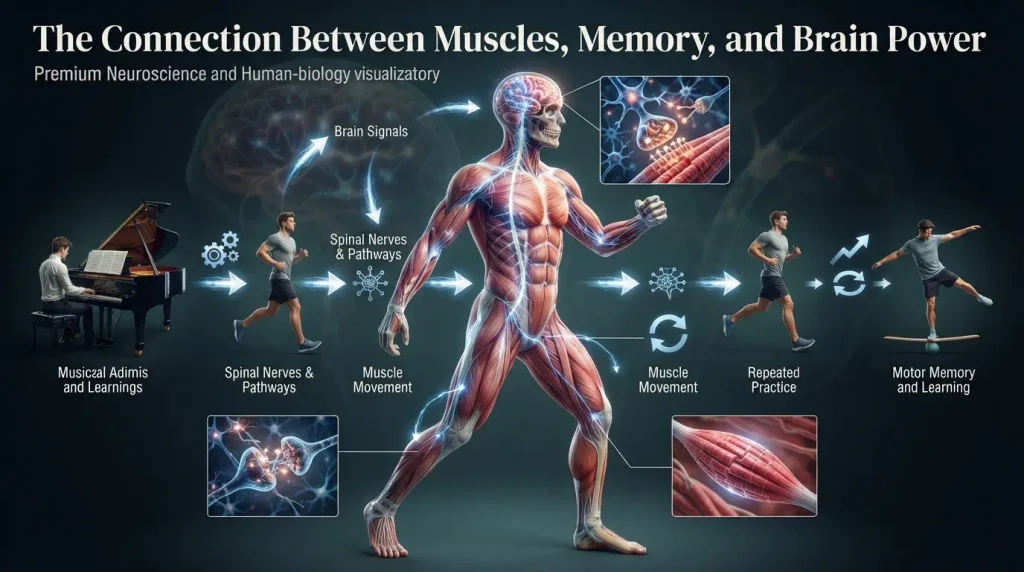
Your muscles share a constant two-way communication line with your central nervous system. Moving your body actively reshapes your brain chemistry for the better.
What Is Muscle Memory?
Muscle memory does not mean your actual muscle tissue holds onto thoughts or memories. Instead, repeated physical movements create smooth, permanent nerve pathways in your brain.
When you learn to ride a bicycle or play an instrument, your nervous system streamlines the movement signal. Eventually, you perform the skill automatically without needing intense focus.
How Working Out Helps Your Brain
Moving your skeletal muscles releases beneficial signaling proteins straight into your bloodstream. These proteins travel directly to your brain, encouraging the growth of healthy new nerve cells.
Regular exercise helps sharpen your focus, improves memory retention, and brightens your overall mood. Taking care of your physical strength keeps your mental faculties sharp too.
Common Myths About Muscles Debunked
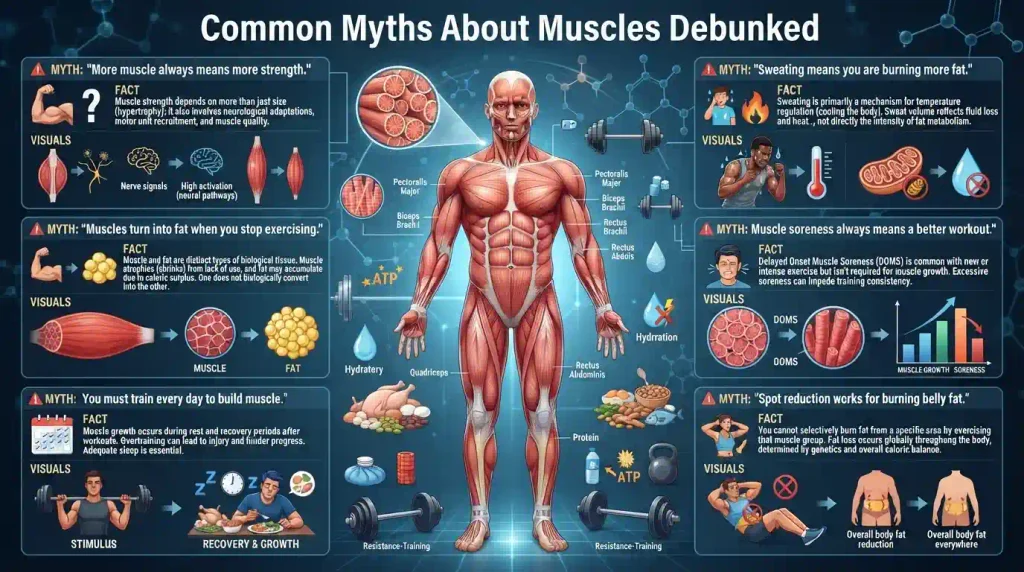
Many popular ideas about fitness and muscle growth are simply plain wrong. Clearing up these classic misconceptions helps you take better care of your body.
Myth 1: Muscle Can Turn Into Fat
Muscle and fat are two completely distinct types of body tissue. Muscle tissue consists of active protein fibers, while fat tissue stores surplus energy in cells.
If you stop working out, your muscle fibers simply shrink in size from lack of use. At the same time, your body may store extra fat if you consume excess calories, but one tissue type never transforms into the other.
Myth 2: You Need Heavy Weights to Build Muscle
Many people assume you must lift heavy iron barbells to develop healthy muscle mass. However, your muscle cells only respond to mechanical tension and physical fatigue.
You can challenge your muscles effectively using bodyweight movements, resistance bands, or light dumbbells. Consistency and proper form matter far more than the total weight on the bar.
Practice Exercise
- What is the largest muscle in the human body?
A. Latissimus dorsi
B. Gluteus maximus
C. Biceps femoris
D. Rectus abdominis - Which muscle is considered the strongest based on its weight?
A. Masseter
B. Heart
C. Calf muscle
D. Tongue - What type of muscle tissue makes up the human heart?
A. Skeletal muscle
B. Smooth muscle
C. Cardiac muscle
D. Rough muscle - How do skeletal muscles create motion across your joints?
A. They push against bones
B. They only pull on bones
C. They expand outward
D. They twist around bones - What is the fastest-acting muscle in your body?
A. Stapedius
B. Orbicularis oculi
C. Forearm flexor
D. Quadriceps - What natural process creates body warmth when you shiver?
A. Rapid muscle contractions
B. Fat burning in cells
C. Slowing blood flow
D. Deep breathing movements - What actually happens to muscle fibers during resistance training?
A. They turn directly into fat cells
B. They stretch out permanently
C. They sustain tiny microscopic tears
D. They multiply in total number - Where is the smallest muscle in the human body located?
A. Inside the big toe
B. Behind the eye
C. Inside the ear
D. At the tip of the nose - Approximately what percentage of total body weight comes from muscle mass?
A. 15 percent
B. 40 percent
C. 70 percent
D. 85 percent - When does the primary repair and growth of muscle tissue take place?
A. While lifting weights
B. During deep sleep
C. Right before eating
D. During light walking
Answer Key
- B 2. A 3. C 4. B 5. B 6. A 7. C 8. C 9. B 10. B
FAQs
1. What are three interesting facts about muscles?
Your body contains over 600 muscles that make up roughly 40% of your body weight. The smallest muscle sits deep inside your inner ear, while the fastest muscle controls your eye blinks. Lastly, your heart pumps continuously without getting tired like skeletal muscles.
2. How do muscles help maintain body temperature?
Muscles generate heat every time they contract and convert energy into physical movement. When you get cold, your body shivers by firing muscle fibers rapidly to create warming heat. This automatic thermal response keeps your core temperature stable in cold environments.
3. Can muscle tissue turn straight into body fat?
No, muscle tissue cannot convert into fat cells under any circumstances. Muscle and fat represent completely different cell types with unique functions. If you stop exercising, muscle cells simply shrink, while unburned calories build up as separate fat storage.
4. Why do muscles feel sore after a hard workout?
Post-workout soreness comes from microscopic tears inside your active muscle fibers. This mild tissue inflammation triggers a normal repair response in your immune system. As your body heals these tiny tears, your muscles become stronger and more resilient.
5. Which muscle in the body works the hardest?
Your heart is without question the hardest-working muscle in your entire body. It continuously contracts around 100,000 times per day without taking a single rest break. It pumps blood constantly to sustain your life from birth onward.
6. How many muscles does it take to smile?
Smiling typically requires the coordinated work of about 12 to 17 facial muscles. In contrast, frowning usually uses around 43 distinct facial muscles. Smiling takes far less physical effort, making it an easy way to brighten your day.
Conclusion
Exploring these fun facts about muscles showcases just how amazing your body truly is. Every step, smile, and heartbeat relies on complex biological machinery working behind the scenes.
Taking care of your muscles through daily movement, good food, and quality sleep helps keep your whole body running smoothly. Staying active preserves your physical independence and keeps your energy levels high.
Now that you know how hard your muscles work for you, give them some love today! Step outside for a refreshing walk, stretch out your tight shoulders, and celebrate the incredible power of your muscular system.

Zoey Carter is the creator and writer behind funsvibe.com, a friendly website where readers can discover interesting, entertaining, and useful content. She enjoys exploring different topics and turning fresh ideas into simple, engaging articles that are easy to understand. Zoey believes that good content should be informative while still feeling natural and enjoyable to read.
Through funsvibe.com, Zoey Carter focuses on sharing original, reader friendly content with a warm and conversational style. She enjoys researching new subjects, discovering helpful information, and presenting ideas in a clear way. Her goal is to make every visit enjoyable while giving readers something valuable to discover and remember.