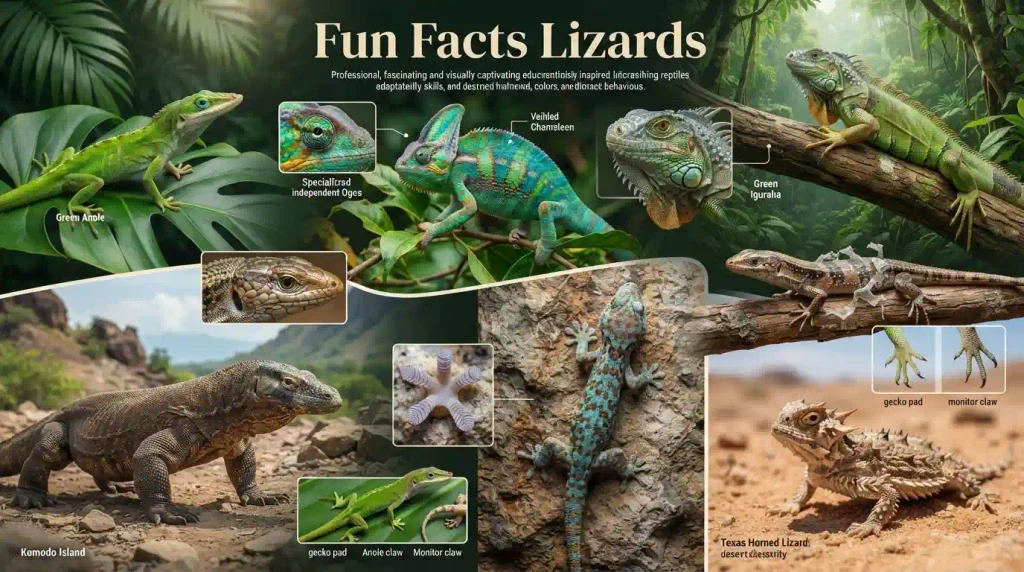
Exploring fun facts, lizards reveal astonishing evolutionary traits, from regenerating lost tails to shooting blood out of their eyes for defense. These incredible reptiles inhabit almost every continent, showcasing wild survival skills, glowing skins, and unique communication methods that make them some of the most fascinating creatures on Earth.
Have you ever spotted a tiny reptile frozen on a warm fence post and wondered what secrets it was hiding? These ancient scale-covered creatures have spent millions of years perfecting some of the weirdest survival tactics in the natural world.
Learning these wild fun facts lizards carry with them will completely change how you view these sun-loving animals. From walking on water to changing colors in a flash, they are living proof that reality is often stranger than fiction.
Whether you are an animal lover, a curious student, or just someone who loves bizarre nature trivia, you are in for a treat. Let’s explore the astonishing world of these modern-day mini dinosaurs together.
The Mind-Blowing World of Reptilian Wonders
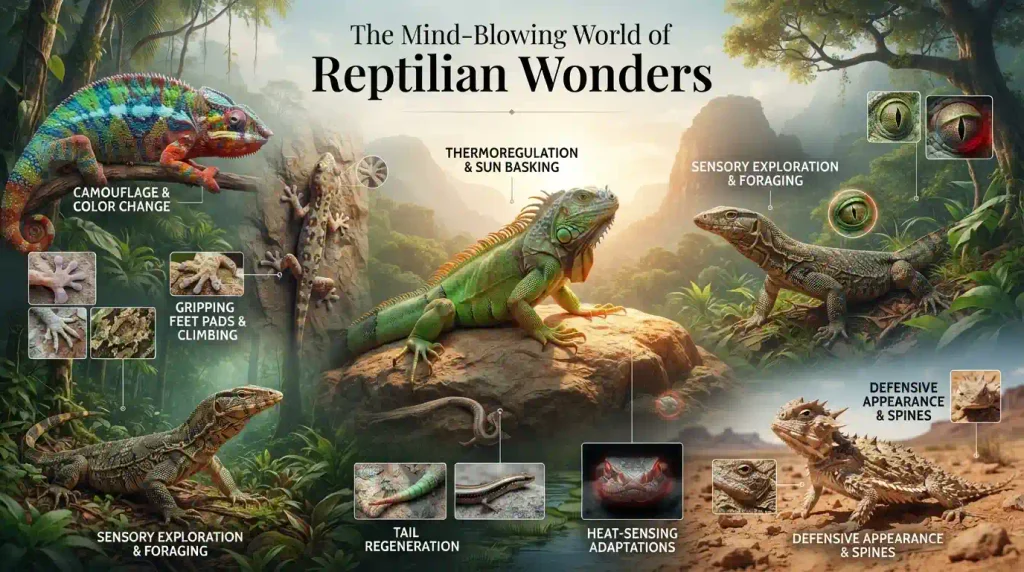
Lizards are far more than just quiet backyard critters that scamper away when you walk past. They belong to an ancient lineage that has adapted to almost every climate on Earth, ranging from scorching deserts to dense tropical rainforests.
Understanding these creatures requires looking closely at how their bodies work in extreme environments. Their survival methods are so unusual that scientists still study them today to design better materials and medical technologies.
Tail Shedding and Regeneration Magic
One of the coolest defense tricks in nature is a process called caudal autotomy, which means self-amputation of the tail. When a predator grabs a lizard by its tail, special muscles contract and snap the bones along pre-made break lines.
The detached tail twitches frantically on the ground for several minutes, distracting the hungry predator while the lizard makes a clean escape. Over the next few weeks or months, the lizard grows a brand-new tail made of cartilage instead of bone.
The Third Eye Phenomenon
Believe it or not, many species possess a “third eye” on the top of their heads known as a parietal eye. While this eye cannot process clear images as their main eyes do, it contains a lens and retina that sense changes in light and movement.
This extra sense acts like a solar-powered alarm system, helping them detect shadows cast by predatory birds flying high overhead. It also helps regulate their internal body clock and control how long they spend basking in the hot sun.
Color-Changing Superpowers Explained
While many people think chameleons change color solely to blend into their surroundings, camouflage is actually just a secondary benefit. The primary reason chameleons shift their skin tones is to communicate their emotions and regulate their body temperature.
Specialized cells under their skin, called chromatophores, expand or contract to reflect different wavelengths of light. Darker shades absorb heat when they are cold, while brighter colors show excitement, fear, or a warning to rival males.
Unbelievable Defense Mechanisms
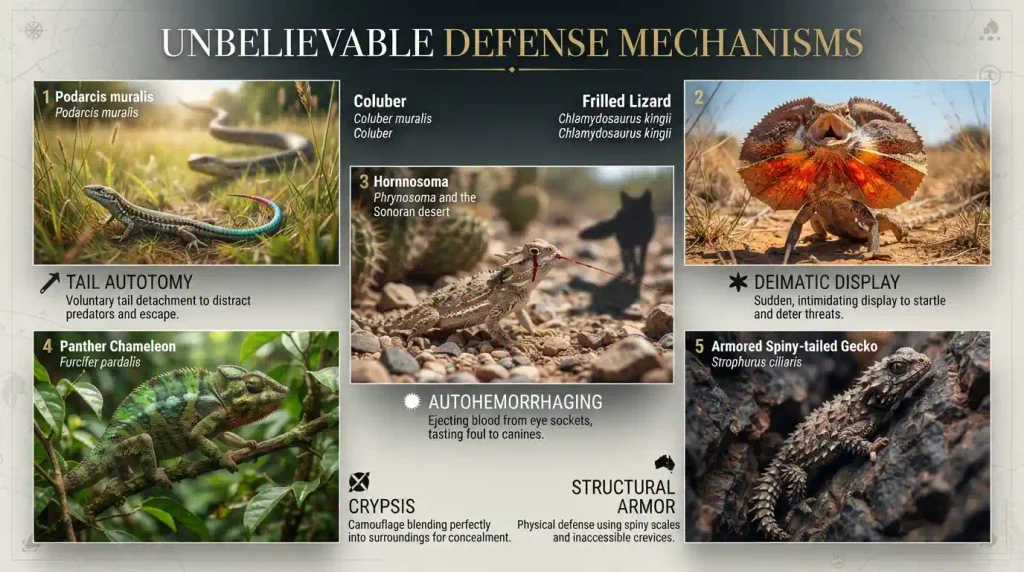
When you are small and live in a world full of hawks, snakes, and coyotes, you need creative ways to stay off the dinner menu. Lizards have developed some of the most dramatic defense mechanisms found anywhere in the animal kingdom.
These instincts are not just clever; they are often completely shocking to witness in person.
Shooting Blood from the Eyes
The Texas horned lizard takes self-defense to a terrifyingly effective level when cornered by a predator like a coyote or dog. By restricting blood flow leaving its head, the blood pressure in its eye sockets surges rapidly.
Tiny blood vessels in the corners of its eyes burst on command, spraying a stream of foul-tasting blood up to three feet away. Predators are instantly confused and grossed out by the taste, giving the little reptile plenty of time to amble away safely.
The Water-Walking Miracle
The green basilisk lizard, famously nicknamed the “Jesus Christ lizard,” possesses the incredible ability to run across the surface of open water. When frightened, it drops onto its hind legs and sprints across streams or ponds at speeds of up to five miles per hour.
Its long back toes feature special fringes of skin that unfurl to trap air bubbles underneath its feet. Combined with a rapid-slapping foot movement, these air pockets create enough upward buoyancy to keep the animal from sinking.
Inflating like a Spiky Balloon
Chuckwallas, large, bulky reptiles native to North American deserts, use the surrounding landscape as a shield against predators. When danger approaches, they quickly wedge themselves deep inside tight rock crevices.
Once safely wedged inside, they gulp down huge lungfuls of air to inflate their bodies like leathery balloons. This swelling locks their spiky scales firmly against the rock walls, making it nearly impossible for a predator to pull them out.
Daily Life and Survival Comparisons
Daily life can look very different across people, animals, and environments, but survival always depends on adapting to challenges. From finding food and shelter to staying safe from danger, every living thing develops unique strategies. Comparing these survival habits reveals fascinating differences in behavior, resource use, communication, and adaptation.
Finding Food and Water
Humans rely on farming, markets, and technology, while animals use instincts and specialized senses to locate food and water in their surroundings.
Shelter and Protection
People build homes for comfort and safety, whereas animals create nests, burrows, dens, or other shelters to protect themselves from weather and predators.
Adapting to Challenges
Survival requires flexibility. Humans use tools and knowledge, while animals depend on instincts, physical adaptations, camouflage, and learned behaviors to overcome daily challenges.
Super Senses and Weird Anatomy
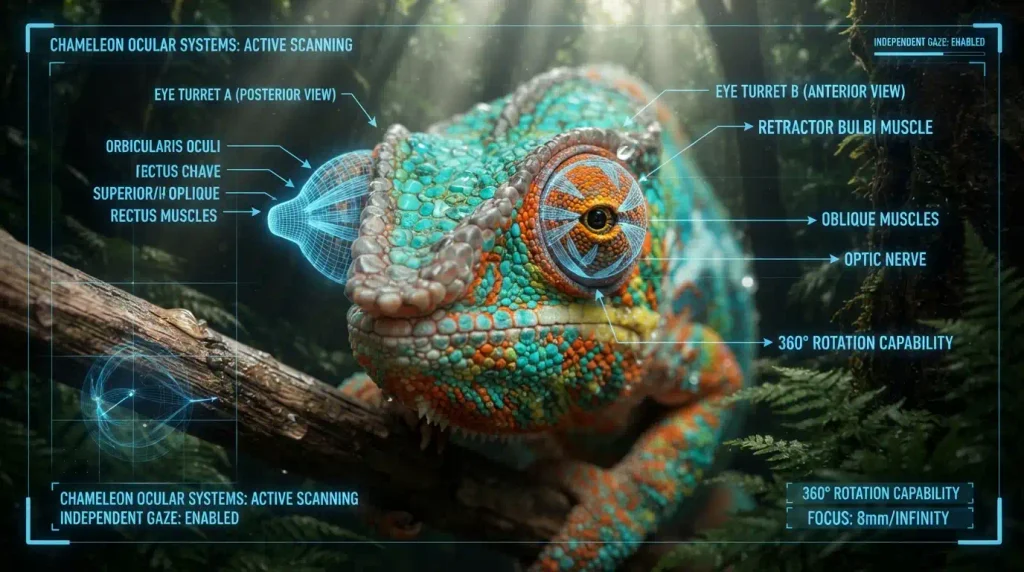
The internal and external body structures of these animals are full of biological surprises. These physiological adaptations allow them to thrive where most mammals would quickly perish.
From how they taste their surroundings to how they cling to flat surfaces, their bodily systems are marvels of natural engineering.
Tasting the Air to Navigate
Have you ever noticed a lizard constantly flicking its fork-shaped tongue in and out? It is not mocking you; it is actually gathering chemical clues from the environment around it.
The tongue collects tiny microscopic scent particles from the air and transfers them to a specialized organ in the roof of its mouth called the Jacobson’s organ. This gives the animal a precise three-dimensional “scent map” of nearby prey, mates, or hidden predators.
Sticky Feet and Molecular Gravity
Geckos can scamper across smooth glass ceilings upside down without dropping an inch, but they do not use sticky liquids or suction cups. Instead, their footpads are covered in millions of microscopic hair-like structures called setae.
These tiny hairs split into even smaller branches that interact with surfaces at an atomic level through electromagnetic forces. This micro-attraction, known as van der Waals forces, creates a powerful bond strong enough to support the animal’s entire weight on a single toe.
The Mystery of Lids and Transparent Eyes
While humans need to blink regularly to keep their eyes moist and clean, many species, including most geckos, do not have movable eyelids at all. Instead, their eyes are protected by a clear, transparent scale called a spectacle.
Because they cannot blink away dirt or dust, they use their long, flexible tongues like windshield wipers to clean off their eyeballs. Imagine licking your own eyes clean after a dusty gust of wind!
Giant Predators and Teeny Miniatures
The range in size across this animal family is absolutely astonishing. You can find species small enough to balance on the tip of a wooden matchstick, as well as giants capable of bringing down large deer.
This massive scale diversity shows how successfully these animals have filled different ecological niches across the globe.
The Mighty Komodo Dragon
Reaching lengths of over ten feet and weighing upwards of 150 pounds, the Komodo dragon reigns supreme as the largest living lizard species on Earth. Native to a few small Indonesian islands, these apex predators hunt pigs, deer, and even water buffalo.
For years, people believed their lethal bite was caused by dirty bacteria in their saliva. Modern scientific research has revealed that they actually possess complex venom glands that prevent blood from clotting, causing their prey to quickly go into shock.
The Teeny Nano-Chameleon
On the complete opposite end of the size spectrum sits the Brookesia nana, commonly known as the nano-chameleon, discovered in the rainforests of Madagascar. Adult males measure less than an inch long from nose to tail, making them small enough to fit easily on a fingernail.
Despite their tiny body size, they possess fully functional eyes, sticky tongues, and hunting instincts identical to their giant cousins. Surviving at such a tiny scale requires an ultra-fast metabolism and specialized diet of tiny mites and springtails.
Extraordinary Diets and Hunting Tactics
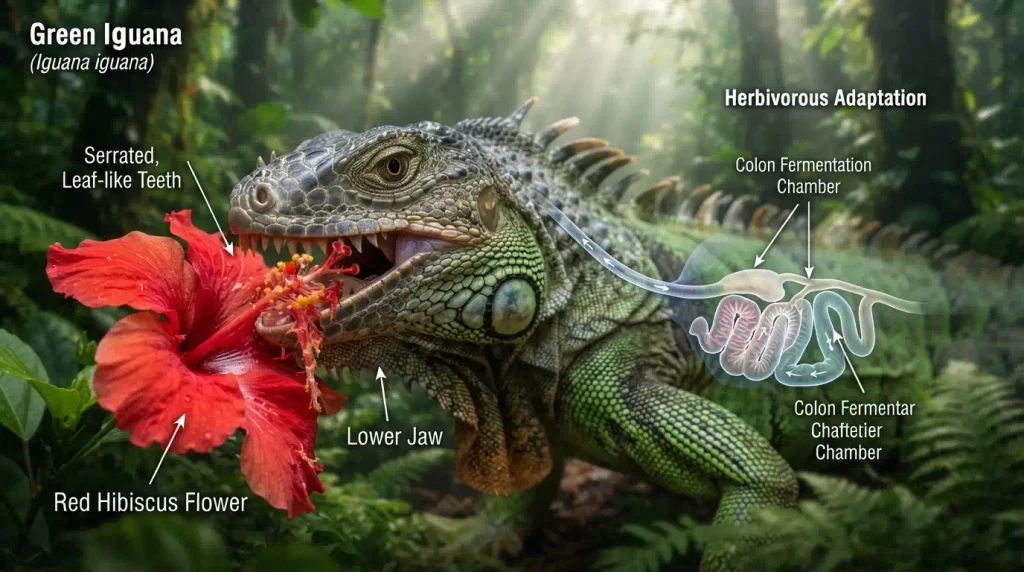
Feeding time in the reptile world is rarely boring. Different species have developed specialized hunting strategies that match their unique environments and physical limitations.
Whether using stealth, speed, or incredible physical strength, these hunters get creative when dinner is on the line.
High-Speed Tongue Projectiles
Chameleons do not chase down their prey through long runs; they sit perfectly still and wait for food to come within range. Once a cricket or fly lands nearby, the chameleon launches its sticky tongue out like a loaded spring.
The tongue can travel at speeds reaching zero to sixty miles per hour in a fraction of a second, expanding up to twice the total length of the animal’s body. The tip of the tongue forms a suction cup that seals tight around the prey before reeling it back in.
Desert Harvesters and Plant Eaters
While most smaller species eat insects, spiders, and worms, several larger species are strict vegetarians or omnivores. Marine iguanas in the Galapagos Islands swim deep underwater to scrape green algae off jagged ocean rocks.
Back in dry inland deserts, spiny-tailed iguanas munch on cactus flowers, dry seeds, and tough leafy bushes. Their digestive systems contain specialized gut bacteria capable of breaking down dense plant fiber into usable energy.
Communication and Social Behaviors
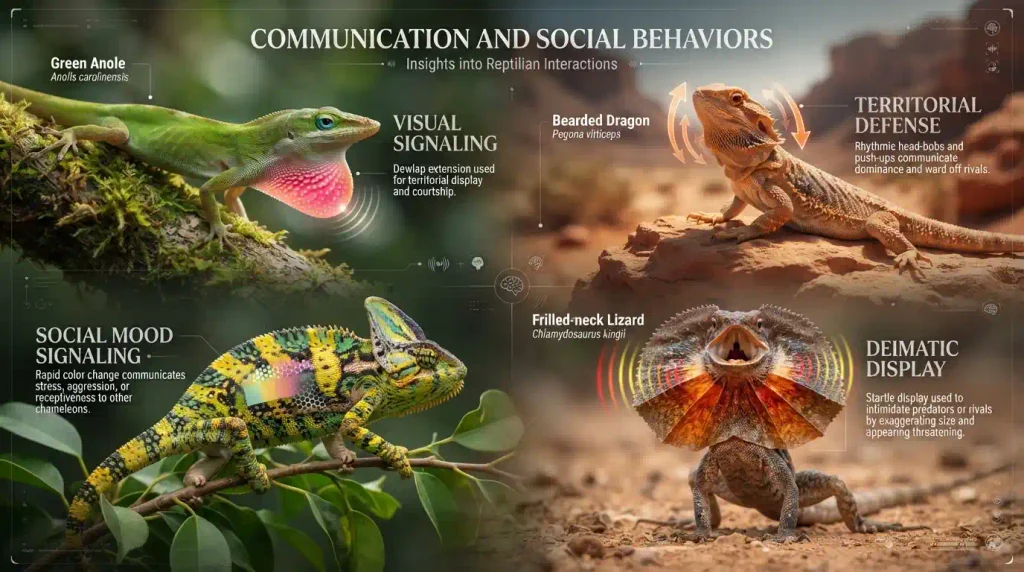
Lizards do not speak with vocal cords like mammals or birds do, but they are far from silent communicators. They use a fascinating body language made of physical gestures, chest inflations, and colorful visual displays.
Recognizing these social cues helps us understand how they establish territory and attract mates without constantly resorting to physical fights.
Push-Ups and Head Bobs
If you ever watch a fence lizard basking on a rock, you will likely see it suddenly perform rapid push-ups or nod its head rhythmically. This display is a clear signal to other animals in the area.
A series of smooth push-ups showcases physical strength and body size to warn rivals off their favorite basking spot. It also reveals bright blue or orange patches hidden along their bellies to attract curious females nearby.
Dewlap Displays
Anoles possess a bright, fan-like flap of skin under their throats known as a dewlap. When an anole wants to stake a claim on a tree branch or impress a potential partner, it pops this brightly colored skin fan outward while bobbing up and down.
These dewlaps come in brilliant shades of yellow, red, orange, and purple. Because different species living in the same forest have different colored dewlaps, it helps them identify members of their own kind quickly.
Practice Exercise
- What physical mechanism allows geckos to walk upside down on smooth glass ceilings?
A. Sticky liquid glands on their toes
B. Tiny suction cups on their feet
C. Microscopic hair structures creating molecular bonds
D. Static electricity built up from running - Why do chameleons primarily change their skin colors?
A. To hide from large predators
B. To communicate emotions and regulate heat
C. To mimic toxic plants
D. To scare away small insects - Which species shoots blood out of its eyes as a defense mechanism?
A. Texas horned lizard
B. Komodo dragon
C. Green basilisk
D. Panther chameleon - What is the main purpose of a lizard’s parietal eye?
A. Seeing colorful fruits at night
B. Detecting shadows cast from above
C. Reading heat signatures of insects
D. Zooming in on far-away targets - How does a basilisk lizard run across open water without sinking?
A. It releases oil to float
B. Its skin repels water molecules
C. Fringed toes trap air bubbles during fast steps
D. Its tail acts like a fast motorboat propeller - What is the process of a lizard breaking off its own tail called?
A. Caudal autotomy
B. Skin molting
C. Thermal shedding
D. Tail budding - What organ processes the scent particles collected by a lizard’s tongue?
A. Pit organ
B. Jacobson’s organ
C. Parietal lens
D. Olfactory gland - Which species is currently recognized as the largest living lizard on Earth?
A. Perentie
B. Saltwater monitor
C. Komodo dragon
D. Gila monster - How do chuckwallas protect themselves inside rock crevices?
A. They spray smelly musk
B. They inflate their bodies with air to wedge tight
C. They bite the rocks to seal the entrance
D. They drop their spiky tails to block the hole - What do green marine iguanas in the Galapagos Islands primarily eat?
A. Small reef fish
B. Sea algae scraped off rocks
C. Dead crabs on the beach
D. Floating seaweed leaves
Answer Key: 1-C, 2-B, 3-A, 4-B, 5-C, 6-A, 7-B, 8-C, 9-B, 10-B
FAQs
1. Are all lizards venomous to humans?
No, the vast majority are completely harmless to humans and do not produce venom. Only a few species, like the Gila monster, beaded lizard, and Komodo dragon, possess specialized venom glands. Even then, they rarely pose a danger to humans unless severely provoked or handled carelessly.
2. How long can a lizard survive without eating?
Most small species can comfortably go several days or weeks without food, depending on their health and environment. Larger cold-blooded species with slow metabolisms, like monitor lizards or iguanas, can easily survive for several months on stored fat reserves in their tails when food is scarce.
3. Can a regenerated tail grow back perfectly?
A regenerated tail rarely looks identical to the original version it replaced. The new tail is supported by a solid rod of flexible cartilage rather than individual bones, making it stiffer. The new scales often feature different colors, shapes, and textures compared to the rest of the body.
4. Why do lizards love basking under hot sun lamps or rocks?
Because they are ectothermic, meaning they rely on external heat sources to regulate their internal body temperature. Basking under the warm sun raises their blood temperature, giving them the energy needed to digest food, run fast, hunt prey, and keep their immune system functioning properly.
5. Do wild lizards make good pets for beginners?
Wild-caught specimens generally make poor pets because they harbor parasites and suffer from high stress levels. However, captive-bred species like bearded dragons, leopard geckos, and crested geckos are wonderful choices for beginners because they are naturally calm, easy to feed, and handle human interaction well.
Conclusion
Learning these fun facts lizards share reveals just how adaptable, mysterious, and entertaining these scaly creatures truly are. From water-running acrobats and color-shifting masters to tiny dragon lookalikes, they never fail to amaze us with their wild survival strategies.
Next time you spot a little lizard warming up on a rock in your garden, pause for a moment to appreciate the millions of years of evolutionary history standing right in front of you. You are looking at a master of survival equipped with incredible natural superpowers.
If you enjoyed discovering these biological wonders, share this guide with your fellow nature lovers or friends who enjoy quirky animal facts. Keep exploring the natural world around you, because there is always something wild waiting to be discovered right in your own backyard!

Zoey Carter is the creator and writer behind funsvibe.com, a friendly website where readers can discover interesting, entertaining, and useful content. She enjoys exploring different topics and turning fresh ideas into simple, engaging articles that are easy to understand. Zoey believes that good content should be informative while still feeling natural and enjoyable to read.
Through funsvibe.com, Zoey Carter focuses on sharing original, reader friendly content with a warm and conversational style. She enjoys researching new subjects, discovering helpful information, and presenting ideas in a clear way. Her goal is to make every visit enjoyable while giving readers something valuable to discover and remember.