
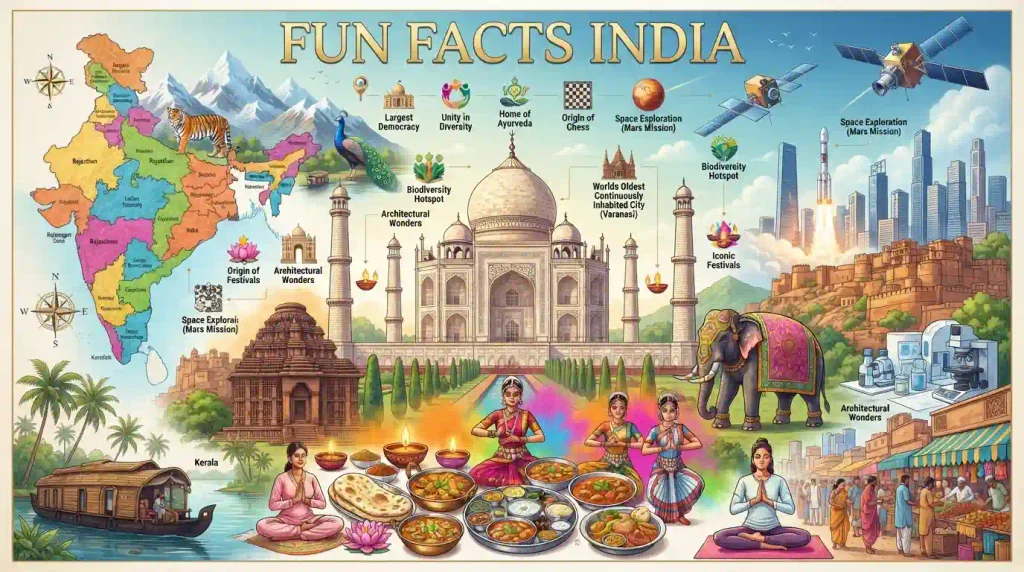
India is a fascinating country with a rich history, incredible biodiversity, and groundbreaking achievements. From being the birthplace of chess, yoga, and zero to housing the world’s highest cricket ground and floating post office, exploring fun facts about India reveals a land of endless wonder, deep cultural traditions, and modern marvels.
The country boasts incredible geographical diversity, featuring everything from the high-altitude deserts of Ladakh to the rain-drenched jungles of Meghalaya where crews grow living bridges from tree roots. India also stands as the exclusive home to the majestic Asiatic lion in Gujarat and harbors over two-thirds of the world’s wild tiger population across its vast protected reserves.
Historically, ancient Indian innovators contributed immensely to global science, mathematics, and medicine. Indian scholars formalized zero and the decimal system, developed early surgical practices documented in ancient texts, and created iconic board games like Chaturanga (chess) and Mokshapat (Snakes and Ladders) to teach strategy and moral lessons.
Today, India seamlessly blends these ancient traditions with modern innovation and incredible social systems. From Mumbai’s century-old Dabbawalas who deliver thousands of home-cooked lunches daily with over 99 percent accuracy to frugal space exploration achievements like reaching Mars and landing near the lunar south pole, India continues to amaze and inspire people around the globe.
The Astonishing Wonders of India
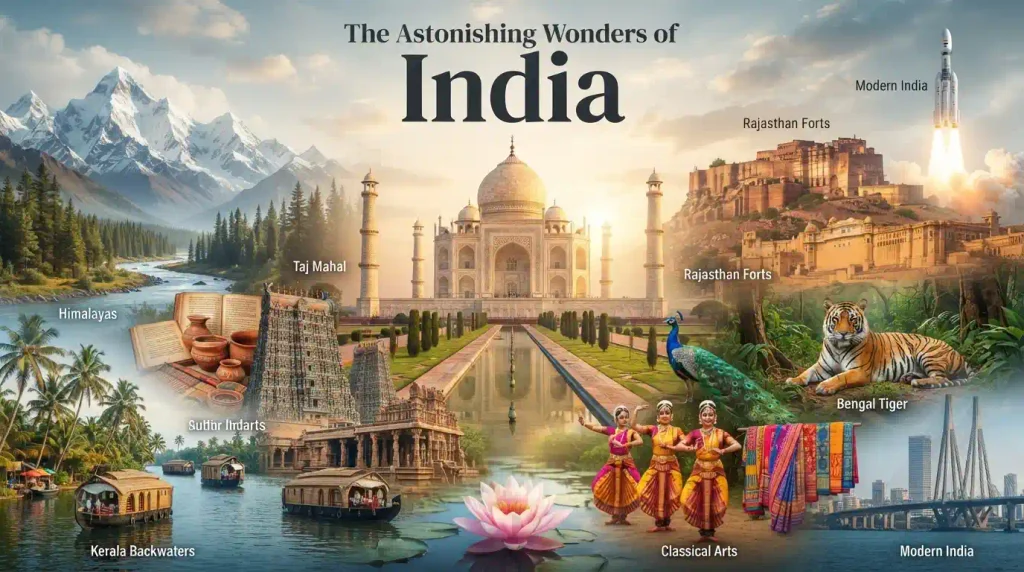
Have you ever wondered which country blends thousands of years of ancient tradition with cutting-edge modern innovation? When you explore fun facts India brings to light, you quickly realize how endlessly surprising this vibrant nation truly is.
Whether you are planning a trip or just love gathering quirky trivia, learning about India is an exciting journey. From towering mountain ranges to mysterious floating structures, there is always something new to uncover about this amazing place.
Let us jump right into some of the most mind-boggling, awe-inspiring, and unexpected realities that make India one of a kind.
Mind-Blowing Geography and Infrastructure
India’s landscape is as diverse as its culture, featuring vast deserts, dense rainforests, towering snow-capped peaks, and sprawling coastlines. Its modern engineering marvels are equally impressive, often defying expectations and breaking global records.
The World’s Highest Motorable Road and Cricket Ground
Did you know that India hosts the highest motorable road in the world? Located in the Ladakh region, the Umling La Pass sits at an astounding altitude of over 19,000 feet above sea level. Driving up here requires courage, careful planning, and plenty of oxygen, as the air is extremely thin.
India also holds the record for the highest cricket ground on Earth. Nestled in the peaceful hills of Himachal Pradesh, the Chail Cricket Ground was built back in 1893. Perched at over 7,500 feet above sea level, playing a game here offers stunning alpine views that few other sports venues can match.
Elevation Comparison of Famous High-Altitude Sites:
- Umling La Pass: Approximately 19,300 feet (Highest Motorable Road)
- Khardung La Pass: Approximately 17,582 feet (Historic High Pass)
- Chail Cricket Ground: Approximately 7,500 feet (Highest Cricket Pitch)
The Floating Post Office of Dal Lake
If you travel to Srinagar in Jammu and Kashmir, you can send a postcard from a truly unusual location. Floating gracefully on the waters of Dal Lake is the world’s only floating post office. It is housed inside a traditional wooden houseboat and operates just like any standard post office.
Locals and tourists alike use this unique facility to send mail stamped with a special seal featuring a boatman rowing a kayak. The post office also includes a small museum celebrating the rich history of the Indian postal network. It is a functional piece of cultural heritage that continues to serve the local floating community every day.
The Living Root Bridges of Meghalaya
Deep within the lush, rain-drenched jungles of Meghalaya, locals have developed a way to grow bridges instead of building them out of concrete or steel. Using the roots of the Ficus elastica tree, indigenous crews guide root systems across raging rivers using hollowed-out tree trunks.
- Over decades, these roots grow strong and thick, naturally intertwining to form sturdy walking paths.
- Unlike artificial bridges that rust and rot in humid climates, living root bridges become stronger as the trees age.
- Some of these natural marvels are over 100 years old and can support dozens of people at a single time.
Ancient Inventions and Historical Firsts
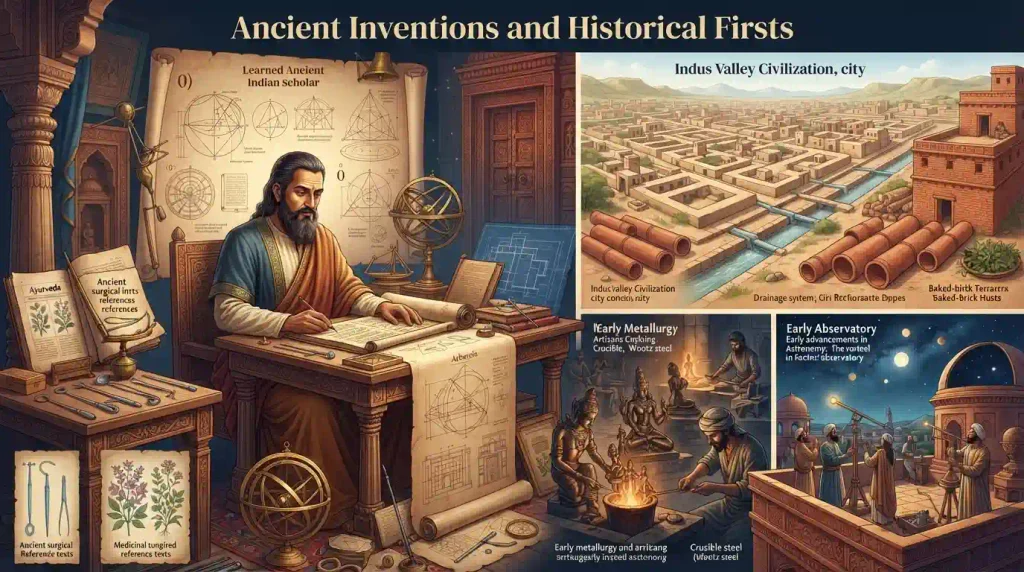
India has contributed immensely to global knowledge, mathematics, health, and entertainment over the millennia. Many everyday items and concepts that we take for granted today actually trace their roots directly back to ancient Indian innovators.
The Invention of Zero and the Decimal System
It is hard to imagine modern mathematics, engineering, or computing without the number zero. The concept of zero as both a placeholder and a numerical value was formalized in India by the brilliant astronomer and mathematician Aryabhata.
Along with zero, ancient Indian scholars developed the decimal system, which revolutionized trade, science, and navigation across the globe. These mathematical tools were later transmitted to the Western world through Arab traders, laying the groundwork for modern scientific achievements.
Snakes and Ladders and the Game of Chess
Board game enthusiasts might be surprised to learn that two of the world’s most famous games originated in ancient India. Chess began as a strategic board game called Chaturanga during the Gupta Empire around the 6th century. It represented four branches of the military: infantry, cavalry, elephants, and chariotry.
Snakes and Ladders, originally known as Mokshapat, was created as a moral lesson for young children.
- Ladders represented virtues like kindness, honesty, and humility, which helped players ascend to higher spiritual levels.
- Snakes represented vices like greed, anger, and theft, which slid players back down toward moral failure.
- Reaching the top of the board symbolized ultimate spiritual liberation or enlightenment.
Early Plastic Surgery and Ayurveda
Long before modern medicine was established, ancient Indian physicians were performing complex surgical procedures. A pioneer doctor named Sushruta wrote the Sushruta Samhita, a foundational medical text detailing surgical techniques, including early forms of rhinoplasty, or nose reconstruction.
India is also the birthplace of Ayurveda, a holistic healing system that dates back thousands of years. Ayurveda focuses on balancing the body, mind, and spirit using natural herbs, dietary adjustments, lifestyle changes, and physical therapy. It remains widely practiced across the globe today as an alternative approach to wellness.
Architectural Miracles and Natural Phenomena
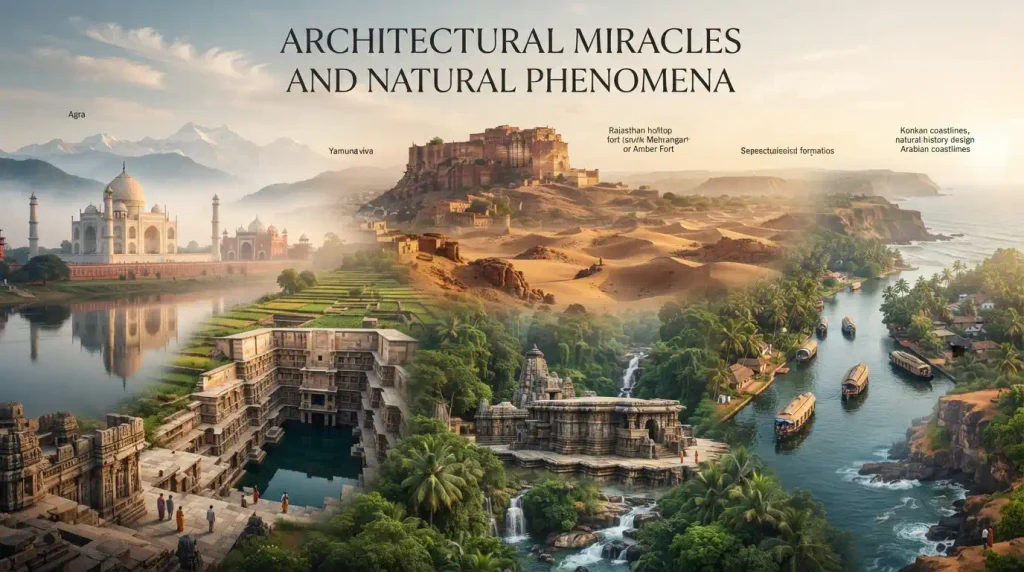
The architectural prowess and geological curiosities found across the subcontinent never fail to amaze visitors. From gravity-defying stones to vast structures visible from space, India’s physical landmarks tell incredible stories.
The Mysterious Anti-Gravity Hill of Ladakh
In the high-altitude desert of Ladakh, there is a stretch of road near Leh known as Magnetic Hill. If you stop your vehicle, shift into neutral, and release the brakes, the car will appear to roll uphill all on its own.
While local folklore speaks of mystical magnetic powers pulling vehicles toward the sky, scientists offer a rational explanation. The phenomenon is actually a striking optical illusion created by the surrounding hilly landscape. The horizon is obstructed, causing a downhill slope to look as though it is tilting upward, tricking the human brain completely.
The Great Wall of India
Most people are familiar with the Great Wall of China, but few know that India houses the second-longest continuous wall on the planet. Enclosing the ancient Kumbhalgarh Fort in Rajasthan, this impressive masonry structure stretches across 36 kilometers.
- The wall winds through scenic hills, valleys, and forests, standing up to 15 feet thick in certain sections.
- It was constructed during the 15th century to protect the fortress from invading armies.
- Today, it stands as a UNESCO World Heritage site and offers visitors a breathtaking glimpse into royal military architecture.
Taj Mahal: A Monument that Changes Color
The Taj Mahal in Agra is renowned worldwide as a masterpiece of Mughal architecture and a symbol of love. However, one of its most enchanting features is how its white marble exterior appears to change color depending on the time of day and weather conditions.
In the early morning, the soft sunlight gives the marble a delicate pinkish glow. By late afternoon, it shines with a bright, milky white radiance under the sun. At night, particularly under the soft glow of a full moon, the structure reflects a subtle, translucent blue tint.
Remarkable Animal Sanctuary and Biodiversity Facts
India is home to an extraordinary variety of wildlife, ranging from royal predators to delicate migratory birds. Protecting these species has led to some incredible conservation success stories across the country.
The Only Home of Asiatic Lions
While Africa is famous for its wild lion populations, India is the sole remaining home of the Asiatic lion. These majestic big cats were once spread across Southwest Asia, but habitat loss and hunting reduced their numbers drastically.
Today, the entire wild population of Asiatic lions lives within the confines of Gir National Park and Wildlife Sanctuary in Gujarat. Thanks to strict government conservation programs and community support, the lion population has steadily recovered from the brink of extinction over recent decades.
A Sanctuary for Bengal Tigers and One-Horned Rhinos
India harbors more than 70 percent of the world’s wild tiger population, protected within dozens of dedicated reserves spread across various states. The Bengal tiger is revered across the country as a symbol of grace, power, and ecological health.
In the northeastern state of Assam, Kaziranga National Park serves as the ultimate stronghold for the Indian one-horned rhinoceros. This UNESCO World Heritage site protects over two-thirds of the total global population of these prehistoric-looking creatures. Visitors on safari can often spot them grazing peacefully in the high marsh grasslands.
Unique Cultural and Heritage Insights

Culturally, India is an astonishing tapestry woven from hundreds of languages, traditions, cuisines, and festivals. Every region offers distinct practices that fascinate outsiders and foster great pride among locals.
The World’s Largest Gathering of Human Beings
The Kumbh Mela is a major sacred pilgrimage that takes place at four rotating river locations across India. Millions of pilgrims gather to bathe in holy waters, believing it cleanses their sins and brings spiritual liberation.
When the Grand Kumbh Mela takes place every 12 years, the sheer volume of attendees breaks global records. Tens of millions of people gather in a single location, making the festival so massive that the dense crowds are clearly visible from satellite photos taken in space.
Hundreds of Spoken Languages and Dialects
India does not have a single official national language. Instead, its constitution recognizes 22 official regional languages, with Hindi and English widely used for administrative purposes.
However, linguists estimate that there are over 1,500 distinct languages and regional dialects spoken across the country every day. Traveling just a few hundred miles can bring you into a region with a unique language, alphabet, cuisine, and traditional attire.
Fascinating Facts About Daily Life and Records
Beyond history and nature, daily life in India is filled with unique systems and world-record achievements that keep the country running efficiently.
The Incredible Mumbai Dabbawalas
In the bustling metropolis of Mumbai, a century-old lunch delivery network operates with breathtaking efficiency. Known as Dabbawalas, this group of over 5,000 delivery workers collects hot home-cooked meals from workers’ homes every morning.
They transport these metal lunchboxes (dabbas) across suburban trains and crowded streets, delivering them directly to office desks by lunchtime. What makes this system famous worldwide is its reliance on a simple color-coded sorting system rather than modern digital software, maintaining an astounding accuracy rate of over 99 percent.
The World’s Largest Postal Network
India operates the most expansive postal network on the planet, with well over 150,000 individual post offices scattered across mountains, deserts, and crowded cities. On average, a single post office serves several thousand citizens, ensuring that even remote rural communities stay connected.
In places like the high mountain village of Hikkim in Himachal Pradesh, you can find a post office operating at over 14,000 feet. Locals and travelers trek up to this remote location just to post mail from one of the highest functional postal stations in existence.
Modern Achievements in Science and Innovation

While India deeply respects its past, it is rapidly establishing itself as a global powerhouse in science, technology, and space exploration.
Frugal Space Exploration Success
India’s space research agency, ISRO, has gained international acclaim for executing complex, high-impact space missions on surprisingly modest budgets. The nation famously reached Mars on its very first attempt with the Mangalyaan mission.
- The Mars craft was built and launched for a fraction of what typical Hollywood space movies cost to film.
- India also became the first country to successfully land a spacecraft near the unexplored lunar south pole with the Chandrayaan-3 mission.
- These achievements highlight the country’s skill in creative engineering and cost-effective problem-solving.
The Tech Capital and Digital Revolution
Cities like Bengaluru, often called the Silicon Valley of India, have become major global hubs for technological research, software development, and modern startup ecosystems. The nation produces hundreds of thousands of talented engineers and tech professionals every single year.
Additionally, India’s rapid adoption of digital payment infrastructure has transformed its domestic economy. Small street food vendors, local artisans, and large retail outlets alike now accept instant mobile payments, making digital transactions seamless across urban and rural regions alike.
Practice Exercise
- Which Indian state is home to the world’s only floating post office on Dal Lake?
A. Rajasthan
B. Kerala
C. Jammu and Kashmir
D. Assam
2. What ancient board game originated in India as a strategic exercise representing four branches of the military?
A. Checkers
B. Chess
C. Backgammon
D. Ludo
3. The living root bridges found in Meghalaya are grown using the roots of which type of tree?
A. Banyan tree
B. Rubber tree (Ficus elastica)
C. Teak tree
D. Neem tree
4. Which ancient Indian mathematician and astronomer formalized the concept of zero as a number?
A. Sushruta
B. Chanakya
C. Aryabhata
D. Varahamihira
5. What natural optical illusion causes vehicles to appear to roll uphill in the region of Ladakh?
A. Solar halo
B. Magnetic Hill
C. Fata Morgana
D. Desert Mirage
6. Gir National Park in Gujarat is famous for being the exclusive wild home of which animal?
A. Bengal Tiger
B. Asiatic Lion
C. Snow Leopard
D. Indian Rhinoceros
7. The second-longest continuous wall in the world encloses which historic Indian fortress?
A. Amer Fort
B. Red Fort
C. Kumbhalgarh Fort
D. Mehrangarh Fort
8. What is the primary function of Mumbai’s famous Dabbawalas network?
A. Postal mail sorting
B. Hot lunch delivery
C. Intercity train ticketing
D. Newspaper distribution
9. Which historic lunar region did India successfully land on with its Chandrayaan-3 mission?
A. Lunar Equator
B. Sea of Tranquility
C. Lunar North Pole
D. Lunar South Pole
10. What ancient text detailed early surgical practices, including plastic surgery techniques?
A. Sushruta Samhita
B. Bhagavad Gita
C. Arthashastra
D. Vedas
Answer Key
C | B | B | C | B | B | C | B | D | A
FAQs
1. What makes India’s geography so diverse and unique?
India features almost every major landscape imaginable within a single country. You can travel from snow-capped Himalayan peaks and high-altitude cold deserts to tropical beaches, dense rainforests, and expansive arid plains, offering incredible natural variety.
2. Why is the invention of zero so significant in Indian history?
The creation of zero transformed mathematics across the entire world. By introducing a functional placeholder and independent numerical value, Indian scholars unlocked advanced arithmetic, algebraic equations, complex architecture, modern engineering, and computing systems used globally today.
3. How are living root bridges created in India?
Indigenous crews in Meghalaya train the aerial roots of rubber trees across riverbeds using hollowed tree trunks. Over several decades, these roots grow together, thicken, and form incredibly strong, naturally self-repairing walking structures across rivers.
4. What is the world’s highest pitch where cricket is played?
The highest cricket venue on Earth is the Chail Cricket Ground, located in Himachal Pradesh. Built in 1893, it sits at an elevation of more than 7,500 feet above sea level amidst majestic forest hills.
5. What is special about the Asiatic lion population in India?
Asiatic lions are a distinct subspecies that once roamed across Western Asia, but today they survive exclusively in Gujarat’s Gir Forest. Dedicated wildlife conservation efforts have successfully brought these rare big cats back from immediate extinction risks.
6. How do Mumbai Dabbawalas achieve such high delivery accuracy?
The Dabbawalas use an elegant, highly organized coding system involving distinct colors, numbers, and symbols stamped on each lunchbox. This visual code allows workers to quickly sort and deliver thousands of meals seamlessly across complex transport networks daily.
7. What was the original purpose behind the game of Snakes and Ladders?
Originally named Mokshapat, the game was developed in ancient India to teach children moral lessons. Ladders represented virtuous behaviors leading toward spiritual liberation, while snakes illustrated vices that caused players to slide down toward failure.
Conclusion
Discovering these unbelievable fun facts India holds reminds us how rich, diverse, and vibrant our world truly is. From engineering feats perched high up in the Himalayas to centuries-old inventions that shaped modern science, gathering interesting fun facts India offers can inspire travelers and curious minds everywhere.
Whether you are fascinated by ancient surgical developments, modern space technology, or the living root bridges of rainy jungles, this vast subcontinent has an endless array of stories to share. Sharing these top fun facts India presents is a great way to appreciate the deep history, culture, and natural beauty that make the country truly one of a kind.
If these insights sparked your curiosity, why not start planning your own journey to experience India’s incredible wonders in person? Pack your bags, stay curious, and get ready to see these breathtaking realities up close!

Zoey Carter is the creator and writer behind funsvibe.com, a friendly website where readers can discover interesting, entertaining, and useful content. She enjoys exploring different topics and turning fresh ideas into simple, engaging articles that are easy to understand. Zoey believes that good content should be informative while still feeling natural and enjoyable to read.
Through funsvibe.com, Zoey Carter focuses on sharing original, reader friendly content with a warm and conversational style. She enjoys researching new subjects, discovering helpful information, and presenting ideas in a clear way. Her goal is to make every visit enjoyable while giving readers something valuable to discover and remember.