
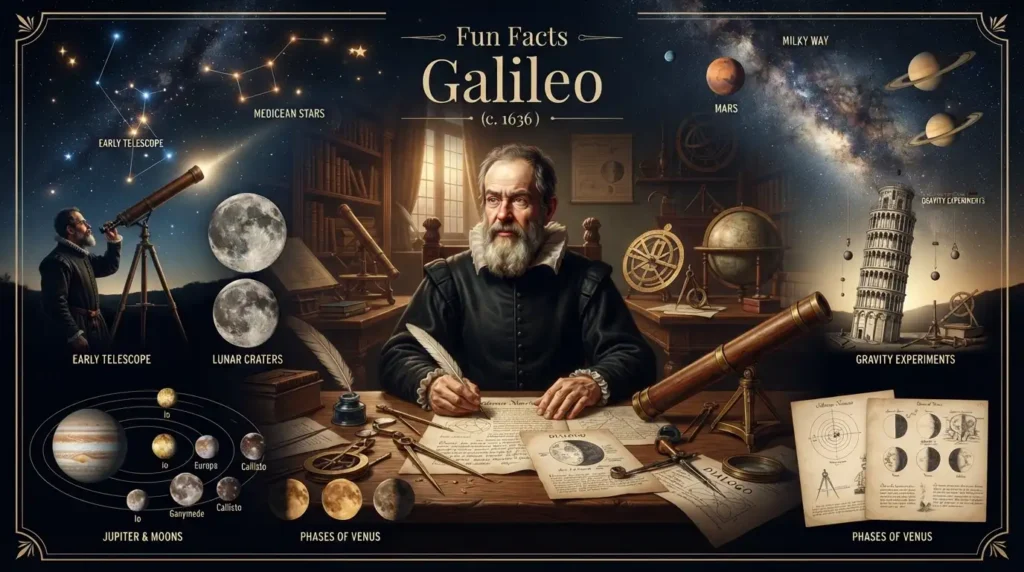
Galileo Galilei was a revolutionary Italian astronomer, physicist, and mathematician born in 1564. Known as the father of modern science, he famously discovered Jupiter’s moons, defended the idea that the Earth orbits the Sun, invented an improved telescope, and spent his final years under house arrest for his bold ideas.
Imagine looking up at the night sky using only your naked eyes, convinced that the whole universe revolves around you. That is exactly how people saw the world until one curious Italian thinker changed everything.
When you look into the wild life of history’s greatest genius, you uncover incredible fun facts about Galileo that make him seem far more human than any history book lets on. He was a passionate inventor, a rebel, and a man who refused to stay quiet when he knew he was right.
From dropping weights off leaning towers to defying powerful kings and popes, the life of Galileo Galilei plays out like a movie script. Let us explore the most surprising, quirky, and awe-inspiring fun facts about Galileo that reveal the man behind the stars.
Who Was Galileo Galilei?
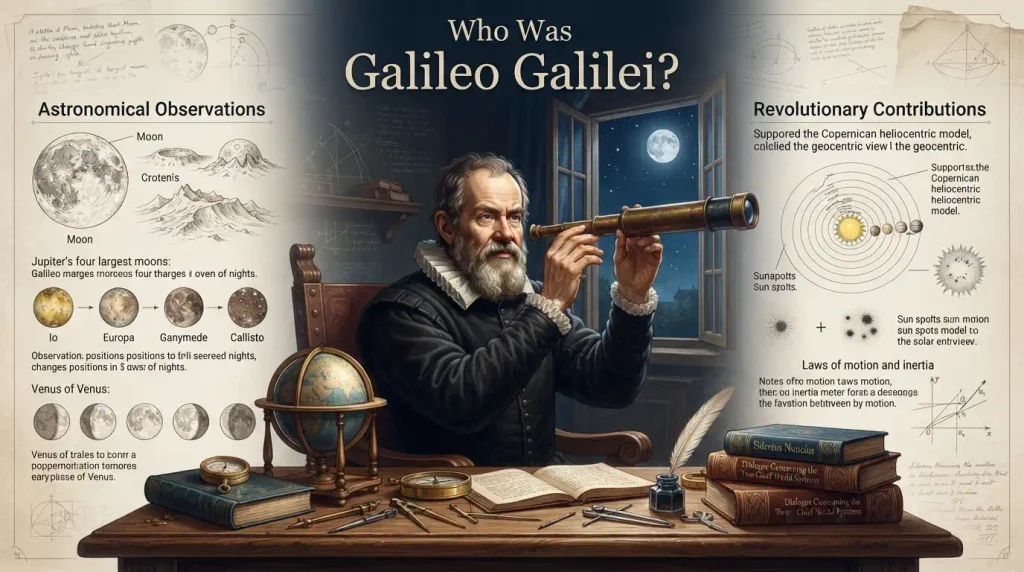
Galileo Galilei was born in Pisa, Italy, on February 15, 1564. He lived during a time called the Renaissance, when art, science, and new ideas were bursting into life across Europe.
His father, Vincenzo Galilei, was a famous musician who taught Galileo to question authority and think independently. That early upbringing pushed Galileo to become one of the most curious minds the world has ever known.
Today, people call him the father of observational astronomy, modern physics, and the scientific method. But long before he earned those fancy titles, he was just a talented kid trying to figure out how things worked.
The Young Rebel with Big Ideas
As a teenager, Galileo did not always fit in with traditional school settings. He was sharp, stubborn, and always ready to start a friendly argument with his teachers.
His family wanted him to study medicine because it paid well, but Galileo quickly fell in love with mathematics and physics instead. He often skipped his medical classes to attend lectures on geometry.
That fiery passion for truth guided every step of his long, noisy, and groundbreaking career.
Mind-Blowing Fun Facts About Galileo and His Discoveries
He Didn’t Actually Invent the Telescope
One of the most common myths is that Galileo created the very first telescope. In reality, a Dutch spectacle maker named Hans Lippershey filed the first patent for a spyglass in 1608.
However, when Galileo heard about this new device, he built his own version in just a few days without ever seeing the original. He vastly improved the design, making it powerful enough to look deep into space.
Instead of charging money to sell telescopes to sailors, he pointed his new instrument up at the night sky. That simple decision changed human history forever.
Jupiter’s Moons Shocked the Whole World
In 1610, Galileo pointed his improved telescope at Jupiter and noticed four tiny light spots nearby. At first, he thought they were distant stars.
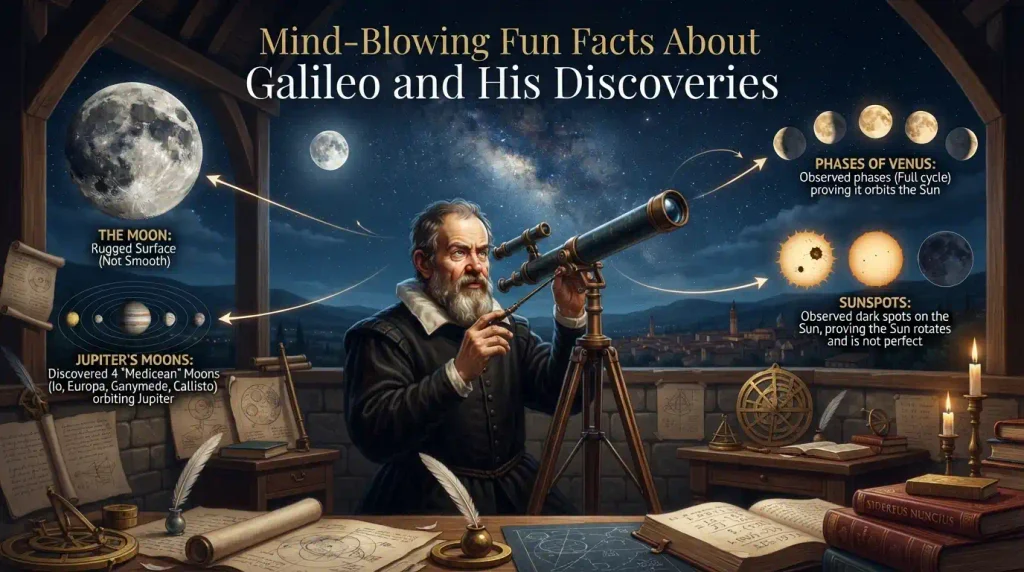
After tracking them over several nights, he realized they were actually moons orbiting the massive planet. This was a massive revelation because it proved for the first time that not everything in space revolved around Earth.
Today, those four moons—Io, Europa, Ganymede, and Callisto—are officially known as the Galilean moons in his honor.
He Saw the Rings of Saturn but Got Confused
When Galileo pointed his lens toward Saturn, he saw something strange on both sides of the planet. His telescope was not quite clear enough to reveal smooth, flat rings.
Instead, he wrote in his notebook that Saturn seemed to have “ears” or two smaller spheres hugging its sides. He died without ever realizing those mysterious shapes were actually beautiful planetary rings made of ice and rock.
The Moon Was Not a Smooth Glass Ball
During the 1600s, standard teaching claimed that all space objects were perfect, smooth glass spheres created by God. Galileo shattered that belief when he drew detailed maps of our Moon.
His telescope revealed rough mountains, deep craters, and jagged valleys all across the lunar surface. He showed the public that the Moon looked surprisingly similar to Earth’s own rocky landscape.
He Discovered Sunspots and Damaged His Eyesight
Galileo spent long hours observing the Sun through his telescope to track dark patches called sunspots. By carefully drawing their movement day after day, he proved that the Sun was actually spinning on its axis.
Unfortunately, looking directly at bright objects through lenses damaged his eyes over time. Many historians believe this risky solar research contributed to his total blindness later in life.
Quirky Personal Fun Facts About Galileo
He Was an Accomplished Musician
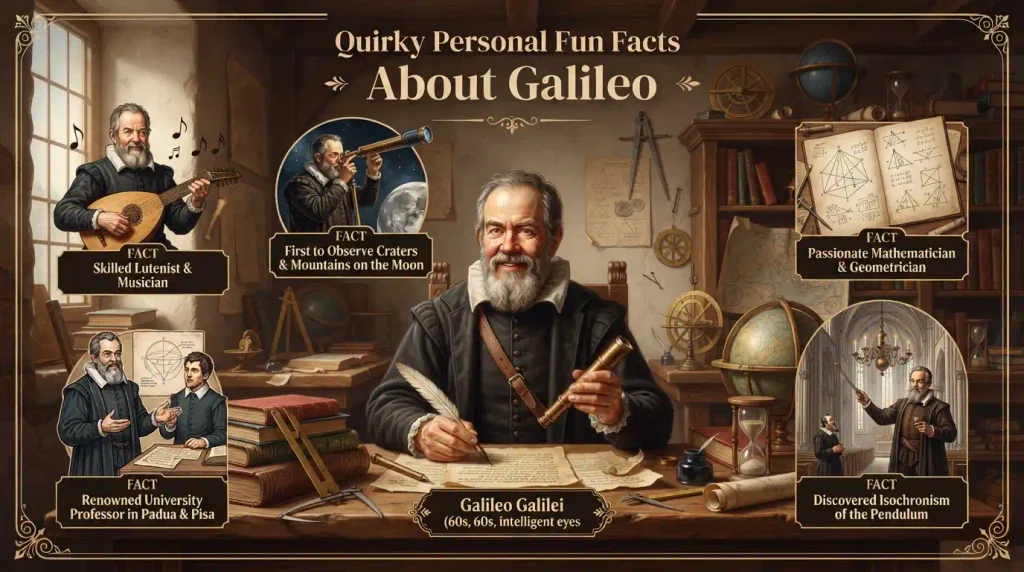
Science was not Galileo’s only talent. Thanks to his father’s strict music lessons, Galileo became a master at playing the lute, an instrument similar to a modern acoustic guitar.
He loved playing music throughout his life to relax after long days of writing and conducting physics experiments. People who heard him play said he had a soft, expressive touch on the strings.
He Never Got Married but Had Three Children
Galileo had a long romantic relationship with a woman named Marina Gamba from Venice. Even though they lived together and shared three children—Virginia, Livia, and Vincenzo—they never officially married.
Because his daughters were born out of wedlock, social customs made it almost impossible for them to find good husbands. Galileo eventually placed both of his daughters in a convent to live as nuns.
His oldest daughter, Sister Maria Celeste, remained his closest friend, trusted companion, and biggest supporter until her early death.
He Was a University Dropout
Despite his incredible intelligence, Galileo left the University of Pisa without earning his medical degree. He was simply so focused on mathematics that he refused to complete his required medical courses.
Even without a formal degree, his brilliant independent papers earned him a prestigious position as a professor of mathematics just a few years later.
He Had a Feisty Personality
Galileo was not a quiet scientist who stayed hidden away in a lab. He loved writing witty, sarcastic responses to scholars who disagreed with his work.
He often wrote his scientific papers in Italian instead of Latin so regular people could read them and laugh at his opponents. That fiery personality won him many fans, but it also created powerful enemies.
He Was Sentenced to House Arrest by the Church
In 1633, the Roman Catholic Inquisition tried Galileo for claiming that Earth moves around the Sun. The official church position at the time was that Earth stayed completely still at the center of the universe.
To save his life, the aging scientist was forced to publicly take back his statements. The court sentenced him to lifelong house arrest at his villa near Florence, Italy.
Legend says that after kneeling and taking back his words, he quietly muttered under his breath, “And yet it moves.”
Inventions and Scientific Discoveries
The Pendulum Clock Revolution
When Galileo was just a young student standing inside the Cathedral of Pisa, he noticed a swinging chandelier overhead. He used his own steady pulse to time how long each swing took.
He was shocked to discover that every swing took the exact same amount of time, regardless of how wide the lamp swung. This realization led to the invention of the pendulum clock, which revolutionized timekeeping across the globe.
The Leaning Tower of Pisa Experiment
Storytellers love to describe Galileo dropping two cannonballs of different weights off the Leaning Tower of Pisa. He wanted to prove that gravity pulls all objects down at the same speed, regardless of their weight.
While some modern historians debate whether he actually threw balls off that specific tower, Galileo certainly performed similar motion tests. He proved that air resistance, not weight, is what slows down falling objects like feathers.
The Thermoscope: Father of the Thermometer
Long before digital weather apps existed, Galileo created a device called the thermoscope in 1593. It used water inside a glass tube to show how air expands when heated and shrinks when cooled.
Although it did not have a clear temperature scale printed on the side, it paved the way for modern weather instruments.
The Long Fight for Truth: Science vs. Tradition
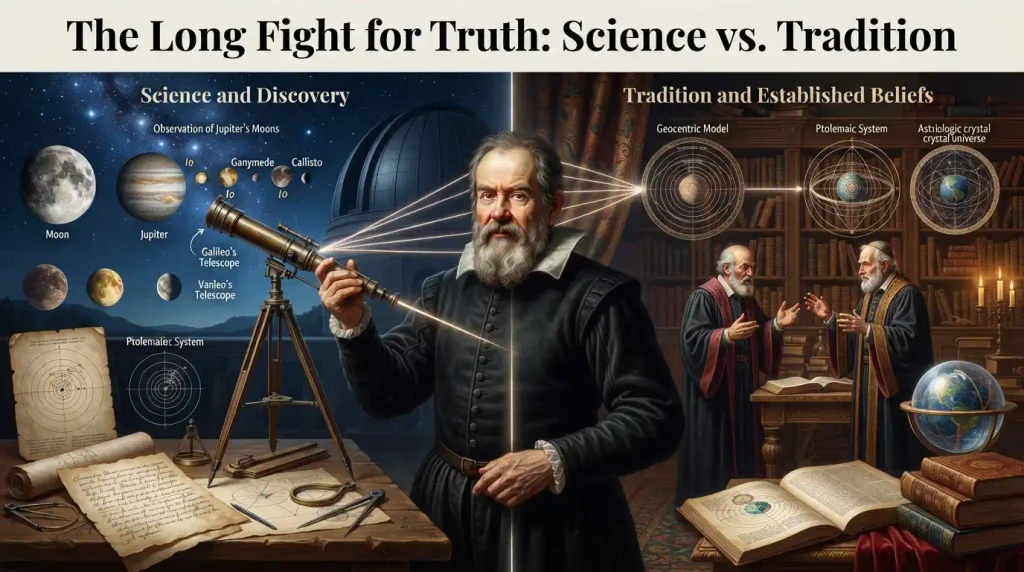
Earth Is Not the Center of Everything
For thousands of years, most people believed in the geocentric model, which claimed Earth was the unmoving center of the universe. Galileo strongly supported the heliocentric model proposed earlier by Nicolaus Copernicus, which put the Sun at the center.
Galileo used his real astronomical observations to show that the Sun-centered model made total sense. His work shifted human thought from ancient myths toward evidence-based scientific facts.
The Famous Trial of 1633
When Galileo published his famous book, Dialogue Concerning the Two Chief World Systems, he wrote it as an engaging conversation between three people. One character, who represented the old Earth-centered view, was portrayed as slow-witted and simple.
Church leaders felt insulted by the character and dragged Galileo to Rome for trial. At 69 years old, weak and facing harsh punishment, Galileo agreed to stop teaching his heliocentric theories publicly.
Vatican Pardons Galileo Centuries Later
Galileo spent his final eight years living quietly under house arrest, but he never stopped working on physics. He lost his sight completely in 1638 and passed away on January 8, 1642, at the age of 77.
It took over 350 years for the Catholic Church to formally review his trial. In 1992, Pope John Paul II issued an official statement admitting that Galileo was right all along and expressing regret over how the trial was handled.
Surprising Facts About Galileo’s Final Resting Place
His Body Was Moved Years After His Death
When Galileo died, his supporters were not allowed to build a proper grand tomb for him due to his church conviction. He was buried in a small side room at the Basilica of Santa Croce in Florence.
Fifty-five years later, in 1737, his remains were moved to an honorable monument inside the main body of the basilica, right across from Michelangelo’s tomb.
Fans Stole Parts of His Body
During the move to his new tomb in 1737, admiring collectors cut off three fingers, a tooth, and a vertebra from Galileo’s body as souvenirs.
For centuries, these strange relics vanished into private collections across Europe. Today, his middle finger is displayed inside a glass egg at the Museo Galileo in Florence, Italy, pointing upward toward the sky he loved to study.
How Galileo Changed Modern Science Forever
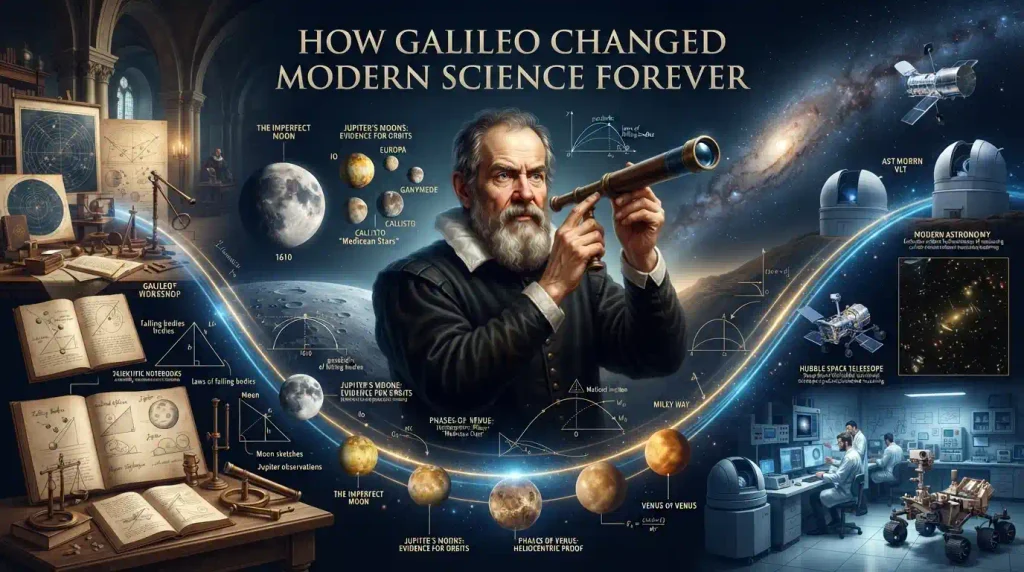
He Created the Modern Scientific Method
Before Galileo, people answered questions about nature by reading ancient books written by thinkers like Aristotle. If an ancient scholar said something was true, people accepted it without testing it.
Galileo insisted on using real experiments, precise measurements, and mathematical formulas to prove ideas. This step-by-step approach became the foundation of modern scientific testing.
He Inspired Sir Isaac Newton
Galileo died in January 1642, the very same year Sir Isaac Newton was born. Newton built directly upon Galileo’s discoveries regarding motion, acceleration, and gravity to develop his famous laws of motion.
Newton famously remarked that if he saw further than others, it was because he stood on the shoulders of giants. Galileo was undoubtedly one of those giants.
Practice Exercise
- Where was Galileo Galilei born?
- A) Rome
- B) Pisa
- C) Florence
- D) Milan
- In which year was Galileo born?
- A) 1546
- B) 1564
- C) 1582
- D) 1600
- Which instrument did Galileo famously improve?
- A) Microscope
- B) Telescope
- C) Compass
- D) Thermometer
- Which planet’s moons did Galileo observe?
- A) Mars
- B) Venus
- C) Jupiter
- D) Saturn
- How many major moons of Jupiter did Galileo discover?
- A) Two
- B) Three
- C) Four
- D) Five
- What did Galileo observe on the Moon?
- A) Mountains and craters
- B) Oceans and forests
- C) Rings
- D) Volcanoes
- Which model of the solar system did Galileo support?
- A) Geocentric
- B) Heliocentric
- C) Lunar
- D) Static
- What was Galileo’s main field of study?
- A) Astronomy and physics
- B) Biology
- C) Chemistry
- D) Medicine
- Which object did Galileo observe changing phases?
- A) Mars
- B) Venus
- C) Jupiter
- D) Mercury
- Why is Galileo remembered as a scientific pioneer?
- A) He built airplanes
- B) He developed important astronomical observations and studies of motion
- C) He discovered electricity
- D) He invented the computer
Answer Key
1-B | 2-B | 3-B | 4-C | 5-C | 6-A | 7-B | 8-A | 9-B | 10-B
FAQs
1. What are three fun facts about Galileo?
Galileo was an expert lute player, dropped out of medical school to pursue math, and never actually invented the telescope. He simply improved the Dutch design to study space objects like Jupiter’s moons.
2. Did Galileo drop objects off the Leaning Tower of Pisa?
Historical accounts suggest he conducted gravity experiments using falling weights, though historians debate whether he used that exact tower. His experiments proved that objects fall at equal speeds regardless of mass.
3. Why was Galileo placed under house arrest?
The Catholic Inquisition sentenced him to house arrest because he actively defended the heliocentric theory. Church leaders held that Earth was the stationary center of the solar system.
4. What did Galileo discover about the Moon?
Galileo discovered that the Moon is not a smooth, perfect glass sphere as ancient thinkers believed. His observations proved that its surface is covered with mountains, deep valleys, and rough craters.
5. How did Galileo influence Isaac Newton?
Galileo’s fundamental work on speed, acceleration, and gravity paved the path for Isaac Newton’s laws of motion. Newton expanded on Galileo’s physics discoveries to build his own theories of universal gravity.
6. What is Galileo’s most famous invention?
His most famous invention was his upgraded astronomical telescope, which magnified objects 30 times. He also invented the thermoscope and perfected pendulum mechanisms for accurate timekeeping clocks.
Conclusion
Exploring these fun facts about Galileo reveals a brave thinker who questioned ancient beliefs to uncover fundamental cosmic truths. From discovering distant moons to challenging standard physics, his work completely reshaped our understanding of Earth and space.
Even when faced with extreme pressure from courts and critics, Galileo stood by his real measurements and observations. His willingness to test ideas through real experiments laid the ground rules for every scientist working today.
Which of these fun facts about Galileo surprised you the most? Share this article with a friend or fellow space fan to spread the awe-inspiring story of history’s greatest astronomer!

Zoey Carter is the creator and writer behind funsvibe.com, a friendly website where readers can discover interesting, entertaining, and useful content. She enjoys exploring different topics and turning fresh ideas into simple, engaging articles that are easy to understand. Zoey believes that good content should be informative while still feeling natural and enjoyable to read.
Through funsvibe.com, Zoey Carter focuses on sharing original, reader friendly content with a warm and conversational style. She enjoys researching new subjects, discovering helpful information, and presenting ideas in a clear way. Her goal is to make every visit enjoyable while giving readers something valuable to discover and remember.