
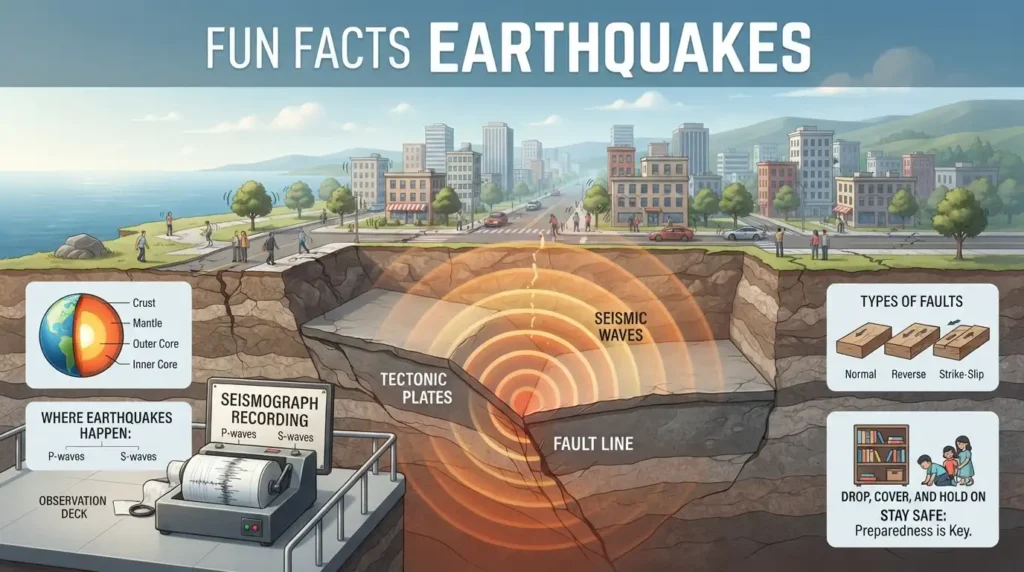
Fun facts earthquakes reveal show that our planet is constantly shifting. From triggering thousands of tiny tremors daily to making Earth spin slightly faster, seismic events demonstrate how dynamic our world really is. Exploring these surprising phenomena helps us understand how tectonic forces actively shape our oceans, mountains, and global landscapes every single day.
Have you ever felt the ground beneath your feet suddenly shake? It is a startling experience that reminds us our planet is constantly moving and changing.
Discovering fun facts earthquakes reveal helps us appreciate the powerful dynamic natural forces working miles below our feet every day. These geological events shape mountains, alter rivers, and constantly redesign our world map.
Let us explore the incredible science of seismic activity together in an easy, clear, and fascinating way!
What Causes the Earth to Shake?
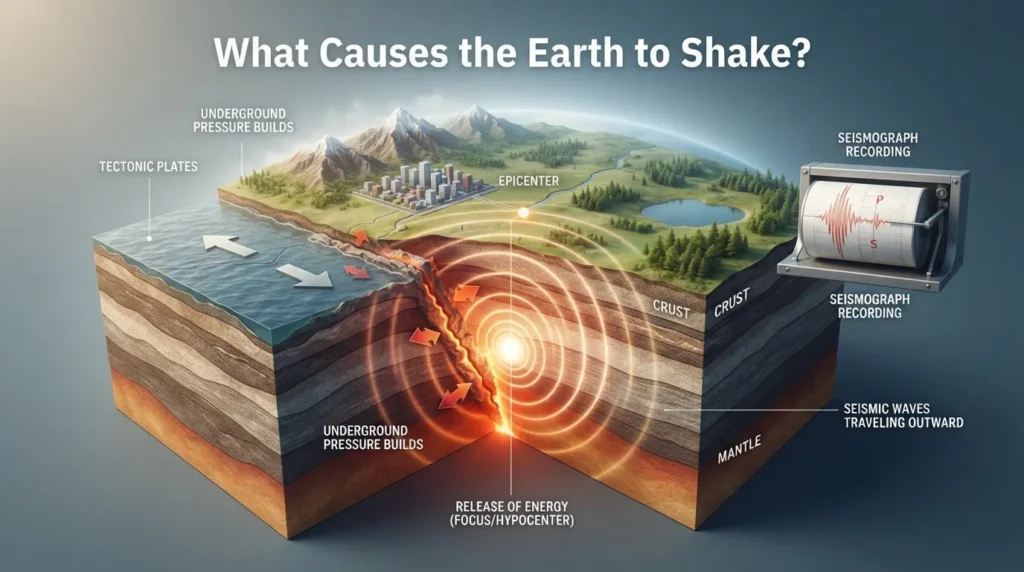
Earth feels solid beneath our feet, but its outer crust is actually broken into massive pieces called tectonic plates. These magnificent slabs of rock float slowly over a layer of hot, soft rock deep inside the planet.
As these giant land masses drift around, their edges frequently touch, slide past one another, or collide. Friction keeps the edges from gliding smoothly, causing immense energy to build up over time.
When the built-up strain finally overcomes friction, the rock snaps and shifts suddenly. This sudden release of stored potential energy sends powerful vibrations rushing outward through the ground in all directions.
The Mechanics of Tectonic Plates
Imagine tectonic plates like giant pieces of a floating jigsaw puzzle covering our planet. They move extremely slowly, usually traveling at about the same speed your fingernails grow every year.
Because their edges are rough, plates often get locked together while the rest of the plate keeps pushing forward. This tension builds for years, decades, or even centuries until the bound rock finally breaks free.
Elastic Rebound Theory Explained Simply
Think of a wooden ruler being slowly bent in your hands. As you apply force, the wood bends and stores energy until it snaps back straight.
In geology, this phenomenon is known as the elastic rebound theory. Rocks deform under pressure until they break, snapping back into place and creating shockwaves that travel to the surface.
Where Do Earthquakes Begin?
The exact spot inside the Earth where the rock breaks is called the focus, or hypocenter. This point can sit just a few miles below the ground or hundreds of miles deep in the Earth’s mantle.
The point directly above the focus on the surface of the land is called the epicenter. This location usually experiences the strongest shaking and receives the most focus during emergency reporting.
Mind-Blowing Fun Facts Earthquakes Reveal About Our Planet
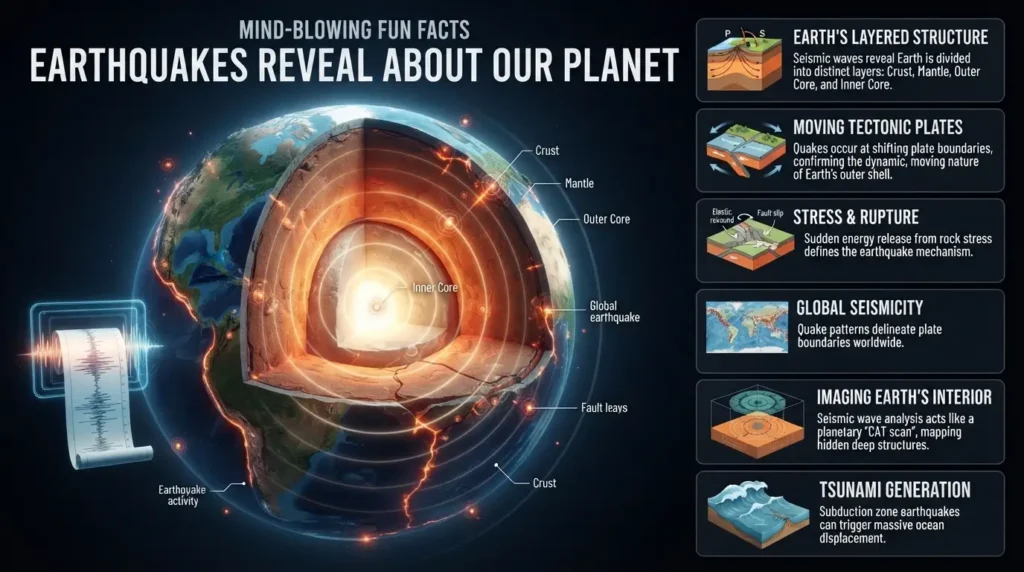
When we explore fun facts earthquakes teach us, we quickly learn that shaking ground is only part of the story. Seismic forces actively shape Earth’s rotation, climate, and geographic boundaries over time.
Earthquakes Can Shorten the Length of a Day
Extremely massive quakes actually alter how fast our planet spins on its axis. When huge landmasses shift closer to Earth’s center of gravity, our planet spins slightly faster, just like a figure skater pulling in their arms.
- The massive magnitude 9.1 Japan earthquake in 2011 sped up Earth’s rotation slightly.
- This intense event shortened the length of an average day by roughly 1.8 microseconds.
- The 2004 Sumatra quake similarly shifted global mass and shortened our day by about 2.68 microseconds.
The Ring of Fire Holds Most Seismic Activity
Around 90 percent of all global seismic events happen along a massive horseshoe-shaped path in the Pacific Ocean known as the Ring of Fire.
- This oceanic zone stretches across 25,000 miles and hosts hundreds of active volcanoes.
- Over 80 percent of the world’s largest quakes occur along this single tectonic boundary.
- Deep ocean trenches form here as heavy oceanic plates slide under lighter continental plates.
Animals May Sense Quakes Before Humans
Many people report seeing domestic pets and wild animals act strangely moments before the ground shakes. Science suggests animals might detect physical clues that humans simply cannot feel.
- Primary waves travel faster than secondary waves and carry high-frequency vibrations animals easily notice.
- Dogs might bark loudly, birds may fly away in flocks, and horses often stampede right before major shocks.
- Sensory organs in small animals can detect faint electrical changes in air and groundwater prior to movement.
Seismic Waves: How Energy Travels Through Earth
When a fault line breaks, it releases energy in waves that travel through rock and soil. These shockwaves travel through our planet much like sound waves move through air or ripples move across a calm pond.
Scientists use delicate instruments called seismographs to track these waves. By studying their speed and direction, experts can calculate exactly where and when an earthquake began deep underwater or underground.
Body Waves: P-Waves and S-Waves
Body waves travel directly through the interior layers of our planet. They are split into primary waves and secondary waves based on how fast they move and how they deform rock.
- Primary waves (P-waves) are fast compressional waves that push and pull rock in the same direction the wave travels.
- P-waves can travel through solid rock, liquid magma, and body water easily.
- Secondary waves (S-waves) arrive second and shake the ground side-to-side perpendicular to the wave’s path.
- S-waves can only move through solid materials, which helped scientists prove Earth has a liquid outer core.
Surface Waves: Love and Rayleigh Waves
Surface waves move along the outer surface of the Earth, much like ripples on top of water. Although they move slower than body waves, they cause the most noticeable ground motion during tremors.
- Love waves shift the ground rapidly from side to side in a flat horizontal motion, damaging building foundations.
- Rayleigh waves roll along the ground in circular patterns, making the land rise and fall like ocean waves.
- Because surface waves concentrate near the top crust, they cause most structural damage to homes and roads.
How Scientists Measure Earthquakes
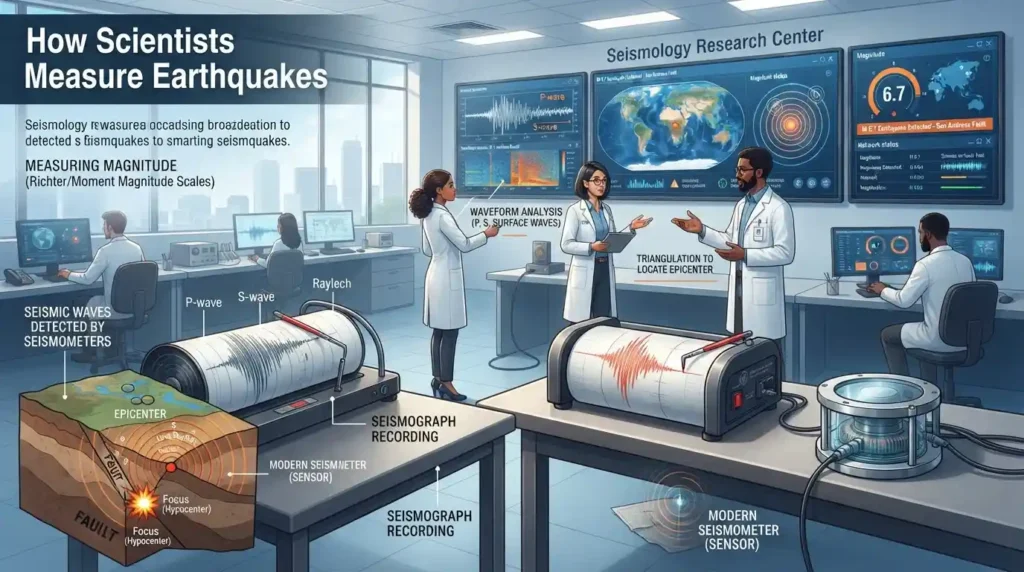
Understanding seismic size requires precise measuring tools. Scientists rely on complex mathematical formulas to record ground movement and assign clear numerical values to every event.
The Richter Scale vs. Moment Magnitude Scale
Many people still hear about the classic Richter scale in news reports, but scientists now prefer modern measurement systems.
Richter Scale measures wave amplitude on a seismograph and works best for local, medium-sized quakes.
Moment Magnitude Scale (Mw) measures total energy released and works best for massive, widespread quakes.
The Moment Magnitude Scale calculates the total energy released by measuring fault line size, movement distance, and rock stiffness. This method offers much higher accuracy for massive global earthquakes.
Understanding the Logarithmic Scale
Magitude scales do not increase in a simple step-by-step straight line. Each full number step represents a massive jump in overall wave amplitude and total energy released.
- A magnitude 6.0 earthquake creates 10 times more ground shaking than a magnitude 5.0 event.
- In terms of raw energy, each full number step releases roughly 32 times more energy!
- A magnitude 7.0 event releases about 1,000 times more energy than a minor magnitude 5.0 tremor.
Major Types of Earthquakes
Not all seismic shaking comes from tectonic movement along massive continental fault lines. Heat, volcanic activity, pressure, and human engineering can also cause sudden ground vibrations.
Tectonic Earthquakes
Tectonic events are by far the most common type of quake experienced on Earth. They happen whenever giant crustal plates shift along fault lines due to stored stress.
These events can happen deep underground or shallow near the surface. Shallow tectonic quakes usually cause much stronger shaking on the surface because seismic waves have less distance to fade.
Volcanic Earthquakes
Volcanic quakes occur alongside volcanic activity as hot molten rock, or magma, pushes upward through solid rock. This force cracks underground structures and generates steady localized tremors.
- Volcanic tremors serve as early warning signs that a volcano might erupt soon.
- These shocks are usually smaller than major tectonic quakes and stay close to the volcanic peak.
- Magma movement produces distinct continuous vibrations known to scientists as harmonic tremors.
Collapse and Explosion Earthquakes
Collapse earthquakes are small local events caused by underground caverns or mines collapsing suddenly. The falling rock sends tiny shockwaves through the immediate neighborhood.
Explosion earthquakes happen when human activities, like underground nuclear testing or heavy quarry blasting, detonate suddenly. The sudden chemical or nuclear explosion drives powerful artificial shockwaves outward through solid ground.
Induced Earthquakes
Human actions can accidentally trigger minor ground shaking. Activities like filling massive artificial reservoirs, mining deeply, or pumping wastewater underground can alter subsurface pressures dramatically.
When high-pressure fluids enter hidden faults, they act like a lubricant. This extra fluid pressure allows locked rock layers to slip much sooner than they naturally would have.
Historic Earthquakes That Changed History
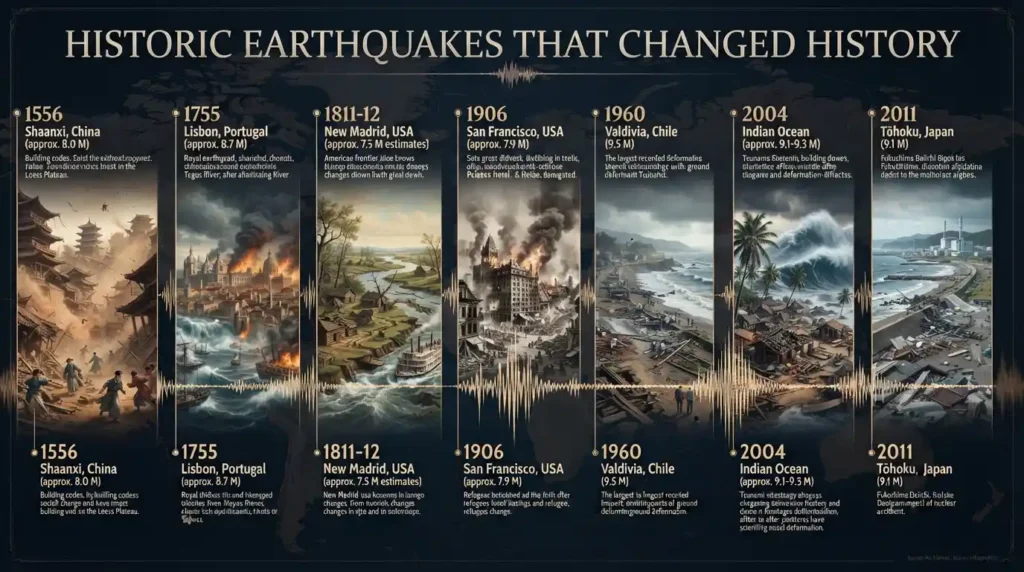
Throughout human history, massive earthquakes have reshaped whole landscapes, destroyed cities, and fundamentally changed how humans build infrastructure.
The 1906 San Francisco Earthquake
Early in the morning on April 18, 1906, a violent rupture occurred along the San Andreas Fault in Northern California. The heavy shaking destroyed thousands of buildings within minutes.
Ruptured gas lines quickly started massive fires that burned across the city for three days straight. This tragic event encouraged engineers to design fire-resistant buildings and modern earthquake-proof architecture.
The 1964 Great Alaska Earthquake
Registering at magnitude 9.2, this giant event remains the strongest recorded earthquake in North American history. It shook the ground violently for over four straight minutes.
The immense shaking collapsed bridges, created massive landslides, and triggered destructive tsunamis across the Pacific Ocean. It gave scientists valuable data that helped confirm tectonic plate theory.
The 2004 Indian Ocean Earthquake and Tsunami
On December 26, 2004, a massive undersea earthquake occurred off the coast of Sumatra, Indonesia. The magnitude 9.1 event shifted millions of tons of ocean water instantly.
The resulting tsunami waves traveled thousands of miles across open water, impacting coastal communities across 14 countries. This event led directly to modern ocean-based tsunami warning networks worldwide.
Earthquake Safety and Preparedness Data
Know the Risks
Understanding earthquake risks helps families prepare for sudden shaking, falling objects, and structural damage. Learn about local hazards and identify safe areas inside your home, workplace, or school.
Prepare an Emergency Kit
Keep essential supplies such as water, food, flashlights, batteries, first-aid items, medicines, and important documents ready. Store the kit where everyone can access it quickly.
Practice Safety Drills
Regular earthquake drills teach everyone how to Drop, Cover, and Hold On. Create an emergency communication plan and practice evacuation procedures to respond calmly and safely during an earthquake.
How Scientists Study Deep Earth Structure Using Quakes
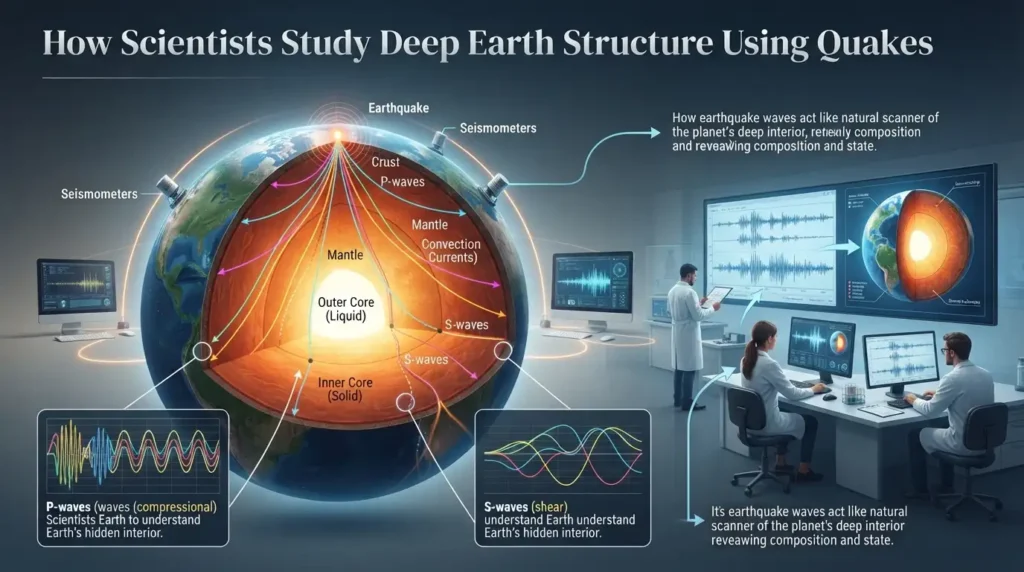
We cannot drill directly to the center of our planet because temperatures and pressures are too extreme. Thankfully, studying how seismic shockwaves travel through deep rock layers acts like a giant planetary ultrasound.
Mapping the Planet’s Hidden Internal Layers
Because P-waves travel through liquids while S-waves cannot, scientists discovered that Earth’s outer core is made of liquid iron and nickel.
When waves hit different rock densities, they bend, bounce, or slow down dramatically. Measuring these wave paths reveals detailed maps of the mantle, crust, and core.
Seismic Tomography Explored
Seismic tomography uses computer models to process signals from thousands of quakes recorded worldwide. Computers build detailed three-dimensional images of deep underground structures using this collected data.
These modern models display giant sinking tectonic slabs, hot rising magma plumes, and hidden rock reservoirs buried thousands of miles beneath our feet.
Earthquakes Beyond Earth: Moonquakes and Marsquakes
Earth is not the only place in our solar system that experiences regular seismic shaking. Delicate sensors placed on celestial bodies prove that space objects experience tremors too!
Fascinating Facts About Moonquakes
Apollo astronauts placed seismic instruments on the lunar surface that recorded thousands of moonquakes over several years. These lunar tremors operate quite differently than normal quakes on Earth.
- Moonquakes can last for over an hour because the Moon is dry, cold, and rigid, allowing waves to bounce around continuously.
- Thermal moonquakes happen when frozen lunar crust expands rapidly as the Sun warms it up during daytime.
- Gravitational pulls from Earth trigger deep moonquakes by squeezing and stretching the Moon’s interior regularly.
Discoveries From Marsquakes
NASA’s InSight lander recorded hundreds of marsquakes during its mission on the Red Planet. These signals provide fresh clues about internal Martian structure.
- Mars lacks active tectonic plates, so its tremors come from the planet cooling down and shrinking over time.
- Cooling causes internal rock layers to crack, stress, and break, generating moderate seismic waves.
- Impacts from falling meteorites also create clear surface tremors that help map the depth of the Martian crust.
Modern Innovations in Earthquake Engineering
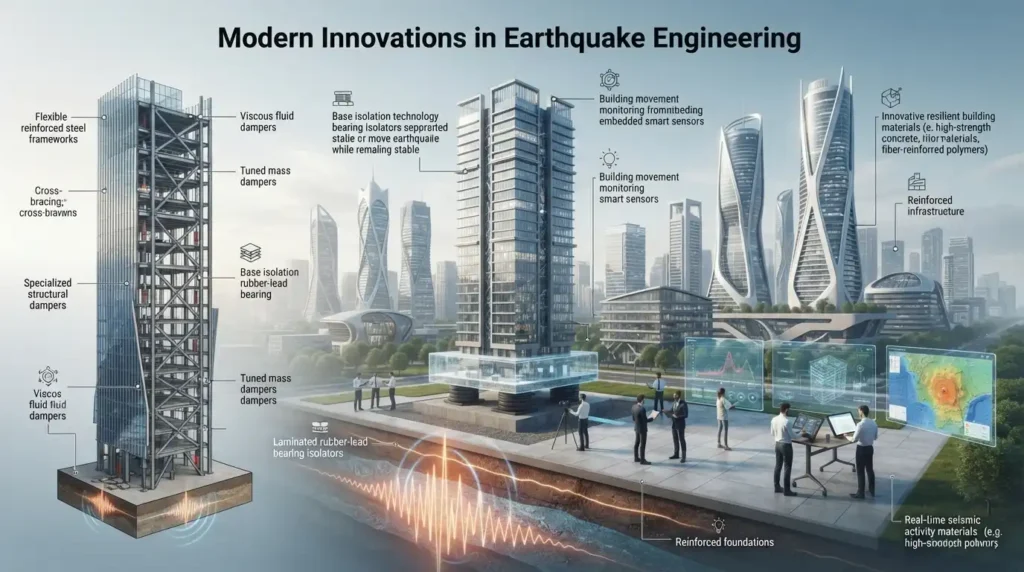
Engineers design modern structures that can absorb, deflect, and resist intense ground motion during sudden seismic events.
Base Isolation Systems
Base isolation acts like a giant shock absorber built directly underneath a building’s primary foundation.
- Structures sit on flexible pads made of tough rubber, steel, and lead layers.
- When ground moves back and forth, the flexible pads stretch while the main building remains steady.
- This design keeps delicate structural frames from snapping or collapsing during sudden shaking.
Damped Outriggers and Tuned Mass Dampers
Tall skyscrapers use giant pendulum weights called tuned mass dampers to counter strong side-to-side movements.
- A massive steel ball hangs suspended near the top floors of a skyscraper.
- When seismic forces push the building right, the heavy pendulum sways left to offset motion.
- This clever engineering counterweight keeps high-rise towers stable during strong winds and earthquakes.
Common Myths About Earthquakes Debunked
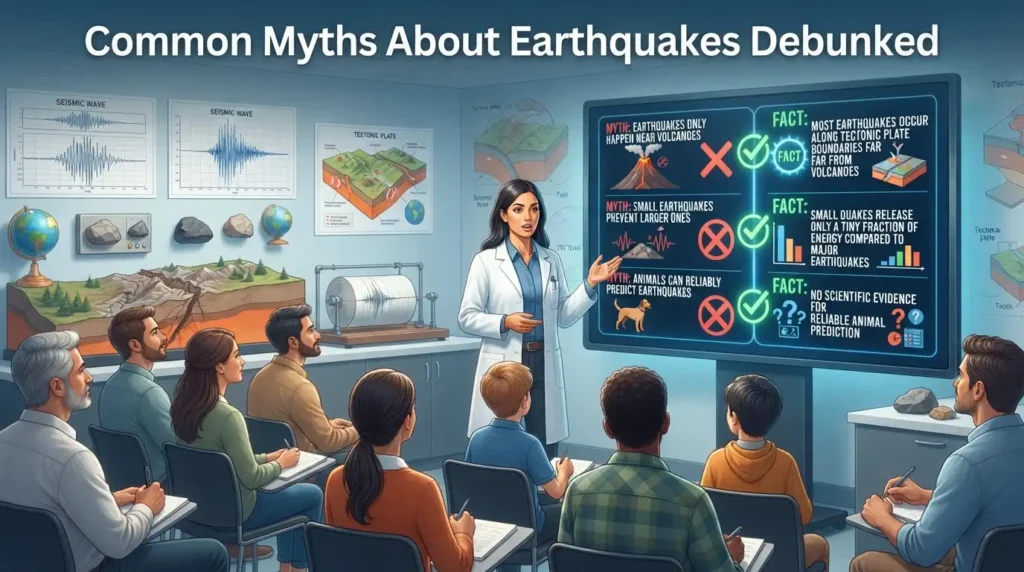
Many widespread ideas about how earthquakes work are actually untrue myths unsupported by modern science.
Myth: “Earthquake Weather” Is Real
Many people believe hot, dry weather brings on earthquakes. In reality, seismic forces originate miles underground where surface weather patterns, rain, or humidity have zero physical impact. Earthquakes happen equally in cold snow, rain, heat, or fog.
Myth: The Ground Can Open Up and Swallow People
Action movies often display giant cracks opening in the ground and swallowing whole cities. Real ground shaking creates small fissures, slides, and cracks, but faults slide past each other rather than pulling wide open.
Myth: Small Earthquakes Prevent Big Ones
People often hope small tremors release built-up stress harmlessly, preventing major quakes. However, it takes thousands of small magnitude 3.0 tremors to equal the energy released by one single magnitude 7.0 quake. Small quakes do not lower major seismic risks significantly.
Practice Exercise
- What causes tectonic plates to move across Earth’s surface?
A. Atmospheric wind currents
B. Ocean tides and lunar gravity
C. Heat and convection currents in the mantle
D. Solar radiation heating rock layers - Which seismic wave arrives first at a recording station?
A. Rayleigh wave
B. Primary wave (P-wave)
C. Secondary wave (S-wave)
D. Love wave - What type of material can S-waves travel through?
A. Solids, liquids, and gases
B. Liquids only
C. Solids only
D. Liquids and gases only - The point directly above an earthquake’s focus on the Earth’s surface is called what?
A. Hypocenter
B. Epicenter
C. Fault line
D. Seismic zone - Approximately how much more energy is released with each full step on the Moment Magnitude Scale?
A. 2 times
B. 10 times
C. 32 times
D. 100 times - What percentage of global earthquakes occur along the Pacific Ring of Fire?
A. Around 25 percent
B. Around 50 percent
C. Around 75 percent
D. Around 90 percent - Why do moonquakes last significantly longer than quakes on Earth?
A. The Moon has stronger gravity
B. The Moon is dry, cold, and rigid with less dampening
C. Tectonic plates move faster on the Moon
D. The Moon has a huge liquid outer core - Which engineering solution acts like a giant pendulum inside skyscrapers to offset sway?
A. Base isolator
B. Tuned mass damper
C. Flexible foundation pad
D. Anchor bolt array - Human-induced earthquakes can be triggered by which activity?
A. Building high-rise towers
B. Pumping fluid waste into deep underground wells
C. Paving large asphalt parking lots
D. Installing solar panels - What did the 2011 Japan earthquake do to Earth’s rotation?
A. Stopped Earth’s rotation briefly
B. Sped up Earth’s rotation by a fraction of a second
C. Slowed down Earth’s rotation by three minutes
D. Reversed Earth’s rotational direction
Answer Key
- C | 2. B | 3. C | 4. B | 5. C | 6. D | 7. B | 8. B | 9. B | 10. B
FAQs
1. Can scientists accurately predict when an earthquake will happen?
No, scientists cannot predict the exact time, date, or location of a future earthquake. They can only estimate the probability of an event occurring within a specific area over a period of decades.
2. Why do some earthquakes cause tsunamis while others do not?
Tsunamis only form when undersea earthquakes cause sudden vertical movement of the ocean floor. Horizontal fault movements shift land sideways, displacing very little water and rarely causing tsunamis.
3. What is an aftershock, and how long can they last?
Aftershocks are smaller tremors that occur in the same region following a major earthquake as the broken crust adjusts. They can continue for days, weeks, months, or even years after a massive event.
4. Is it safe to stand in a doorway during an earthquake?
Standing in a doorway is no longer recommended for modern buildings because doorways are rarely stronger than surrounding walls. It is much safer to drop, cover under a sturdy table, and hold on tight.
5. What should you include in a home emergency earthquake kit?
A standard kit should hold fresh water, non-perishable food, a flashlight, a first-aid kit, extra batteries, sturdy shoes, and necessary medications. Pack enough supplies to sustain your household for at least three full days.
6. Can weather changes trigger seismic activity?
Surface weather changes like rain, wind, or high temperatures cannot trigger deep earthquakes. Seismic stress builds miles underground where surface weather conditions have no physical influence or effect.
Conclusion
Learning about fun facts earthquakes teach us highlights how vibrant, active, and constantly changing our planet really is. From shortening our days slightly to shaping ocean floors, seismic activity reminds us that Earth is constantly evolving beneath our feet.
Understanding how seismic waves travel, how structures resist shaking, and how to prepare empowers us to stay safe while appreciating earth science. Ground movement is simply part of living on a dynamic, living planet.
Keep exploring nature with curiosity, share these surprising facts with your friends, and always stay curious about the powerful forces shaping our world every single day!

Zoey Carter is the creator and writer behind funsvibe.com, a friendly website where readers can discover interesting, entertaining, and useful content. She enjoys exploring different topics and turning fresh ideas into simple, engaging articles that are easy to understand. Zoey believes that good content should be informative while still feeling natural and enjoyable to read.
Through funsvibe.com, Zoey Carter focuses on sharing original, reader friendly content with a warm and conversational style. She enjoys researching new subjects, discovering helpful information, and presenting ideas in a clear way. Her goal is to make every visit enjoyable while giving readers something valuable to discover and remember.