
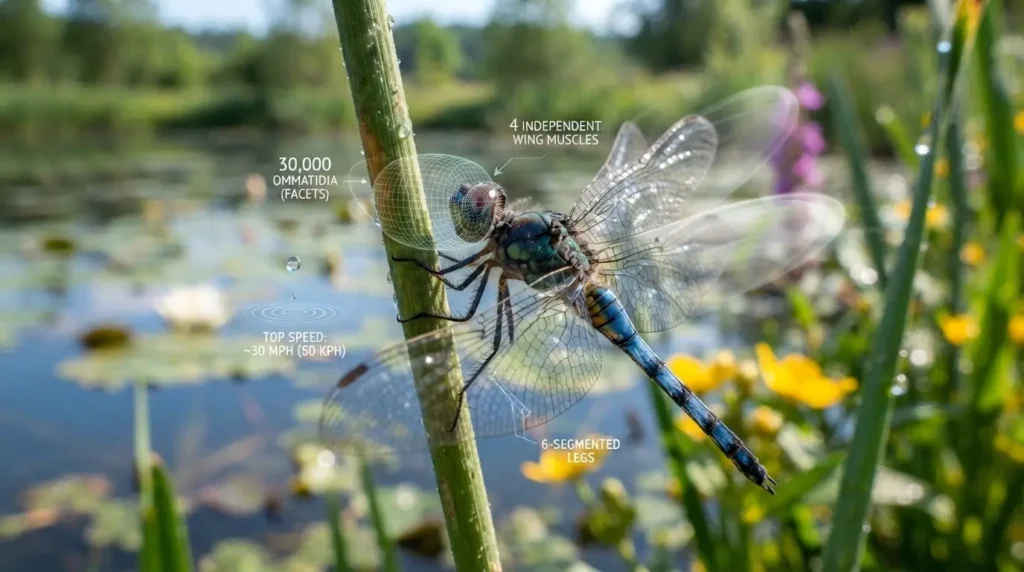
Dragonflies are ancient, master hunters with 360-degree vision and incredible flight capabilities. Studying a fun facts dragonfly list reveals how these colorful insects catch up to 95% of their prey, fly backward, and have inhabited Earth for over 300 million years, pre-dating the dinosaurs.
Have you ever watched an iridescent insect hover over a pond and wondered how it pulls off such unbelievable aerial stunts? Uncovering a surprising fun facts dragonfly list is the best way to understand these colorful creatures patrolling your backyard.
These ancient flyers are far more than just pretty garden visitors. When you explore every fun facts dragonfly detail, you discover one of the most efficient apex predators on the planet.
Let’s explore the hidden world of these fascinating insects and see what makes them true marvels of nature.
The Ancient Giants of the Sky
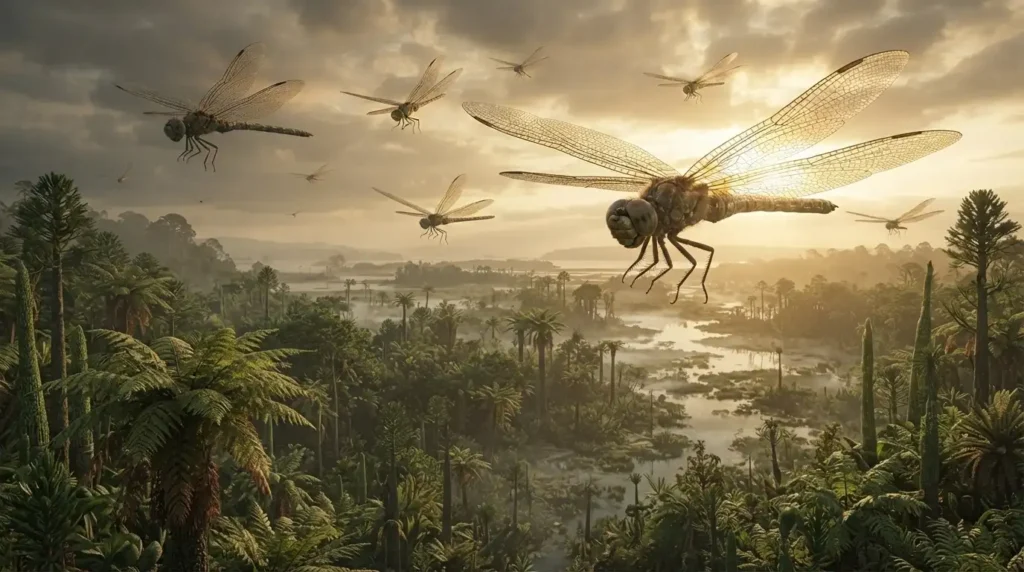
Long before giant reptiles walked the Earth, ancient ancestors of modern dragonflies ruled the air. These prehistoric insects belonged to a group known as griffinflies.
Monster Wingspans of Prehistory
Imagine walking through a prehistoric swamp and spotting an insect the size of a crow. The ancient Meganeura lived around 300 million years ago and boasted a wingspan reaching over two feet wide.
High oxygen levels during the Carboniferous period allowed these giant insects to grow to unbelievable sizes. As atmospheric levels changed over millions of years, their body sizes shrank down to the nimble species we see buzzing around today.
Pre-Dating the Dinosaurs
Dragonflies have survived multiple mass extinction events. They were flying through prehistoric marshes around 100 million years before the very first dinosaurs ever evolved.
Their fundamental body blueprint was so successful that evolution barely needed to alter it. When you watch a modern dragonfly, you are literally looking at a living fossil.
Masters of Aerial Acrobatics
If combat jet engineers want to build better aircraft, they study dragonfly wings. These insects possess flight abilities that leave modern human technology in the dust.
Four Independent Wings
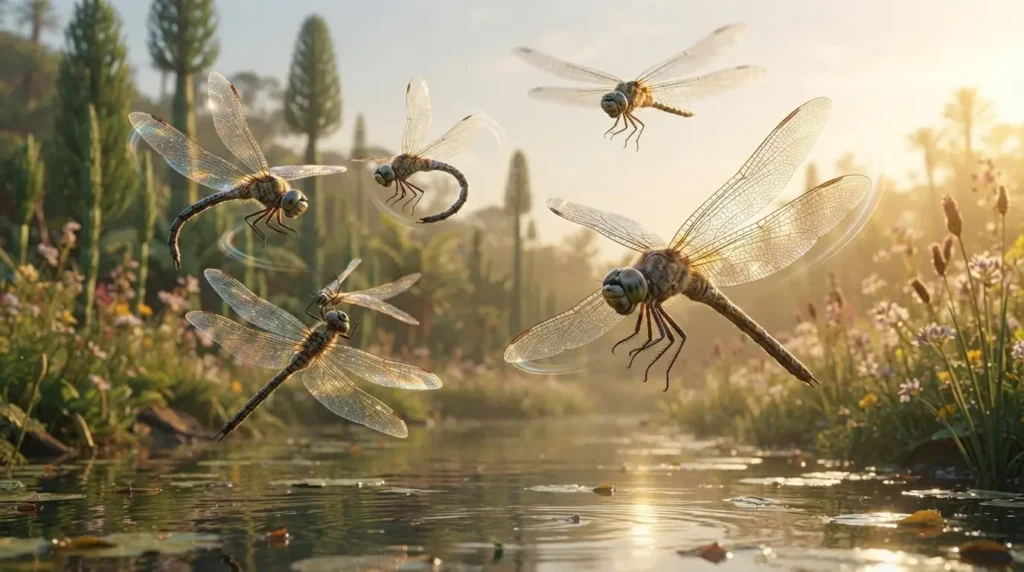
Unlike houseflies or bees, dragonflies have four distinct wings that operate independently. Each wing is connected to separate muscle groups attached directly to the thorax.
- They can fly backward and upside down.
- They can hover in place for over a minute.
- They can change direction instantly at full speed.
- They can fly upside down to escape predators.
This unique setup allows them to tilt individual wings to alter angle, thrust, and lift in milliseconds.
Speed Demons of the Insect World
While hovering looks effortless, dragonflies can move with astonishing speed when chasing prey. Many species cruise comfortably at 30 miles per hour.
In short bursts, larger species can reach speeds up to 35 miles per hour. That makes them among the fastest flying insects on planet Earth.
Nature’s Ultimate Hunters
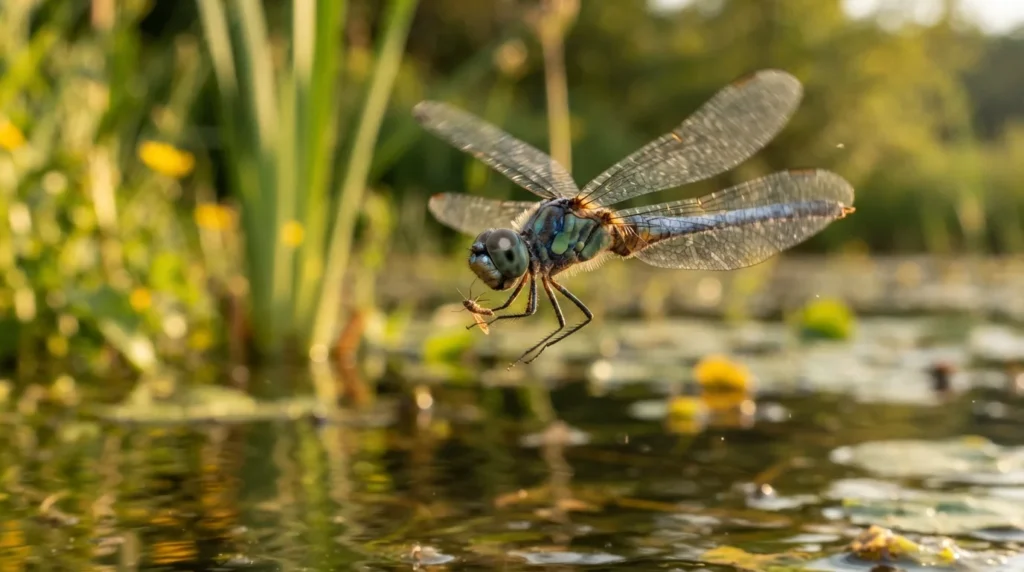
They might look delicate and graceful, but dragonflies are terrifyingly efficient hunters. Their hunting success rate makes large mammalian predators like lions look completely amateur.
The 95% Hunting Success Rate
A lion catches its prey roughly 25% of the time, and a cheetah succeeds about half the time. A dragonfly succeeds in catching its target an astonishing 95% of the time.
They do not simply chase down mosquitoes from behind. Instead, they calculate velocity and trajectory to ambush prey from below and behind, snatching it mid-air before the victim even notices.
The Intercept Strategy
Dragonflies perform complex spatial mathematics inside their tiny brains while hunting. They do not fly directly toward where their prey currently is.
Instead, they fly toward where their target will be in a fraction of a second. This interception technique mirrors how military targeting systems operate today.
Superpowered Vision
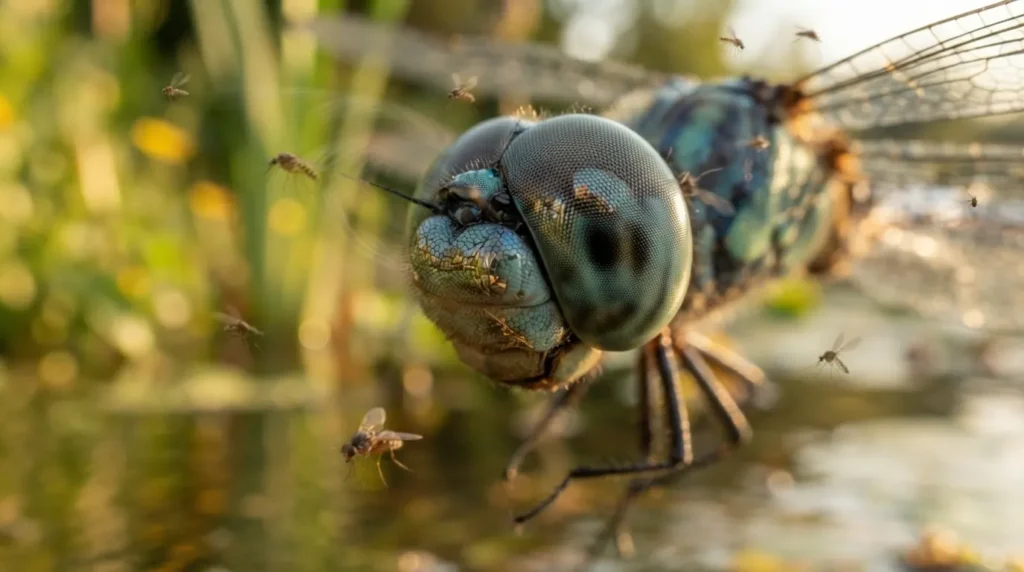
If you look closely at a dragonfly, its head seems to be made almost entirely of two giant compound eyes.
Thousands of Individual Lenses
A single dragonfly eye contains up to 30,000 individual units called ommatidia. For comparison, a typical housefly has around 6,000.
This visual array gives them nearly 360-degree vision. The only true blind spot they have is located directly behind their head.
Seeing Colors Humans Cannot Imagine
Humans see the world using three color receptors: red, green, and blue. Dragonflies can possess anywhere from 15 to 30 different color opsin proteins.
- They can see polarized light patterns in water.
- They perceive ultraviolet light naturally.
- They process visual information much faster than humans, making movements appear in slow motion.
This visual system allows them to spot tiny midges against dark foliage or glowing water reflections with ease.
The Secret Underwater Life
Most people associate dragonflies with warm summer skies, but they spend the majority of their lives submerged underwater as nymphs.
Years Underwater, Weeks in the Air
Depending on the species, a dragonfly stays in its aquatic nymph stage anywhere from one to five years. They shed their skin up to 15 times as they grow beneath the surface.
In stark contrast, their adult phase above water usually lasts only a few short weeks or months. The main purpose of their adult stage is simply to reproduce and lay eggs.
Jet-Propelled Underwater Predators
Dragonfly nymphs are fierce aquatic carnivores that consume mosquito larvae, worms, tadpoles, and even tiny fish.
To move quickly, they pull water into their anal cavity and blast it out forcefully behind them. This natural jet-propulsion system shoots them forward to escape larger fish or strike at prey.
Global Travelers and Migration Secrets
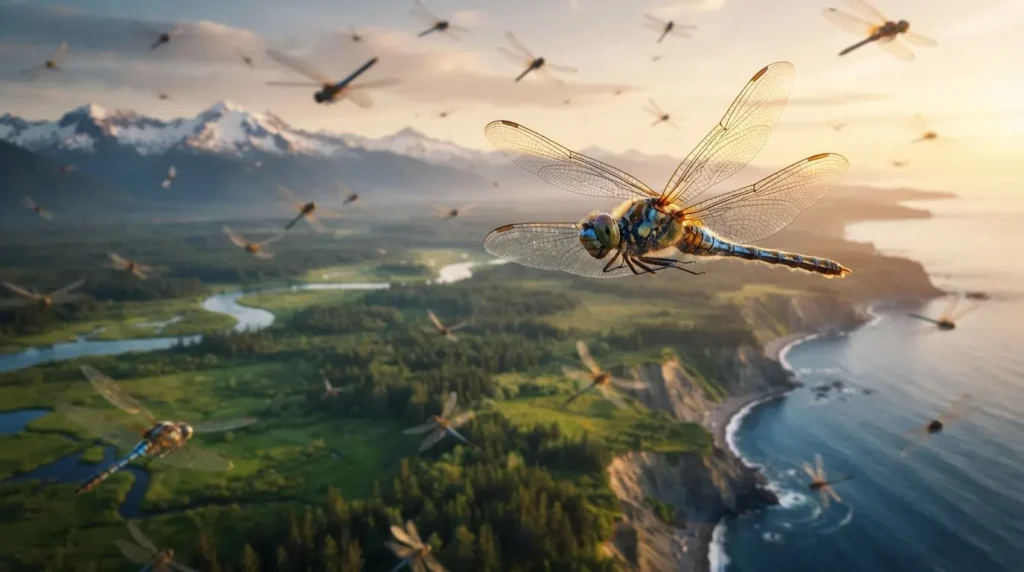
We often think of monarch butterflies when discussing insect migration, but dragonflies are equally impressive long-distance travelers.
The Globe Skimmer Journey
The Globe Skimmer dragonfly holds the record for the longest insect migration route known to science. Individual populations travel across the Indian Ocean between India and Africa.
This incredible journey covers over 11,000 total miles across multiple generations. They use seasonal monsoon winds to assist their oceanic crossing.
Cold Weather Adaptations
Dragonflies are cold-blooded creatures that rely on sun heat to warm up their flight muscles. If their body temperature drops too low, they simply cannot fly.
To warm up on chilly mornings, they perform wing-whirring movements to generate internal heat. Others perch on warm rocks to absorb heat before taking off.
Practice Exercise
- What was the approximate wingspan of the prehistoric dragonfly ancestor Meganeura?
A. 6 inches
B. 12 inches
C. Over 2 feet
D. 5 feet - What percentage of hunting attempts by a dragonfly are successful?
A. 25%
B. 50%
C. 75%
D. 95% - How many independent wings does a dragonfly have?
A. Two
B. Four
C. Six
D. Eight - How long can a dragonfly remain in its aquatic nymph stage?
A. 1 to 3 days
B. 2 to 4 weeks
C. Up to 5 years
D. Over 10 years - Which optical ability allows dragonflies to see light spectra invisible to humans?
A. Infrared detection
B. Ultraviolet vision
C. X-ray perception
D. Sonar imaging - How do dragonfly nymphs propel themselves quickly through water?
A. Webbed feet
B. Rapidly fanning external gills
C. Jet propulsion out of their anal cavity
D. Beating small wing pads underwater - What is the approximate visual field coverage of a dragonfly’s compound eyes?
A. 90 degrees
B. 180 degrees
C. 270 degrees
D. Nearly 360 degrees - Which dragonfly holds the record for the longest insect migration route?
A. Green Darner
B. Globe Skimmer
C. Blue Dasher
D. Emperor Dragonfly - How do dragonflies catch their prey in mid-air?
A. Chasing behind until the prey gets tired
B. Trapping prey in silk webs
C. Intercepting prey by predicting its future path
D. Poisoning prey with small stingers - How many color receptors can dragonflies possess in their eyes?
A. Up to 3
B. Up to 7
C. Up to 12
D. Up to 30
Answer Key
1: C | 2: D | 3: B | 4: C | 5: B | 6: C | 7: D | 8: B | 9: C | 10: D
FAQs
1. Do dragonflies bite or sting humans?
Dragonflies do not have stingers and cannot sting you. While large species can technically nip your skin with their jaws if held tightly, they rarely break the skin and prefer to escape rather than bite humans.
2. What is the difference between a dragonfly and a damselfly?
Dragonflies hold their wings flat and spread outward at rest, while damselflies fold their wings back along their body. Dragonflies also have eyes that touch or nearly touch, whereas damselflies’ eyes are distinctly separated.
3. What do dragonflies like to eat most?
Dragonflies eat flying insects, especially mosquitoes, midges, gnats, and flies. Larger species will also eat moths, butterflies, and smaller dragonflies when hunting over ponds and open fields.
4. How long do dragonflies live as adults?
Most adult dragonflies live for only a few weeks to two months. Their adult lifespan focuses primarily on hunting, finding mates, and laying eggs before cooler weather arrives.
5. Why are dragonflies important for backyard gardens?
Dragonflies act as natural pest controllers by eating hundreds of biting insects like mosquitoes every single day. Having them around your garden keeps mosquito populations down without relying on chemical sprays.
Conclusion
Working through a comprehensive fun facts dragonfly guide shows that these magnificent insects are far more than beautiful summer backyard flyers. They are ancient, living marvels of natural engineering, having refined their aerial acrobatic skills, 360-degree vision, and unmatched 95% hunting accuracy over 300 million years of survival on Earth.
Beyond their breathtaking physical abilities, dragonflies play a crucial ecological role in preserving our natural environments. By feeding on thousands of pests like mosquitoes and midges, they maintain balanced ecosystems around freshwater ponds and gardens without the need for harmful chemical sprays.
The next time you spot a brilliant dragonfly hovering gracefully over a lake or back garden, take a moment to admire its incredible evolutionary journey. You are observing a living dinosaur-era predator that continues to inspire modern flight engineers, biophysicists, and nature lovers around the world.

Zoey Carter is the creator and writer behind funsvibe.com, a friendly website where readers can discover interesting, entertaining, and useful content. She enjoys exploring different topics and turning fresh ideas into simple, engaging articles that are easy to understand. Zoey believes that good content should be informative while still feeling natural and enjoyable to read.
Through funsvibe.com, Zoey Carter focuses on sharing original, reader friendly content with a warm and conversational style. She enjoys researching new subjects, discovering helpful information, and presenting ideas in a clear way. Her goal is to make every visit enjoyable while giving readers something valuable to discover and remember.