
Fun Facts Space reveals how enormous and mysterious our universe really is. Space contains billions of galaxies, countless stars, planets, moons, asteroids, and other fascinating objects. Even our Solar System has many surprising features that make learning about the universe exciting and full of discovery.
One of the most interesting fun facts about space is that the Sun contains more than 99% of the total mass in our Solar System. Planets also have incredible differences. Jupiter is the largest planet, Mercury is the closest to the Sun, and Neptune travels around the Sun at an enormous distance.
Space is also filled with extraordinary phenomena. Black holes have gravity so powerful that even light cannot escape from them. Neutron stars are incredibly dense, while supernovas can release tremendous amounts of energy. These objects help scientists explore how stars are born, change, and eventually disappear.
Another fascinating aspect of fun facts about space is that the universe is constantly changing. Galaxies move, stars form and die, and planets continue orbiting their stars. Modern telescopes allow scientists to observe distant galaxies and discover new worlds, helping us understand our place within the vast cosmos.
Cosmic Basics: What Is Space Really Like?
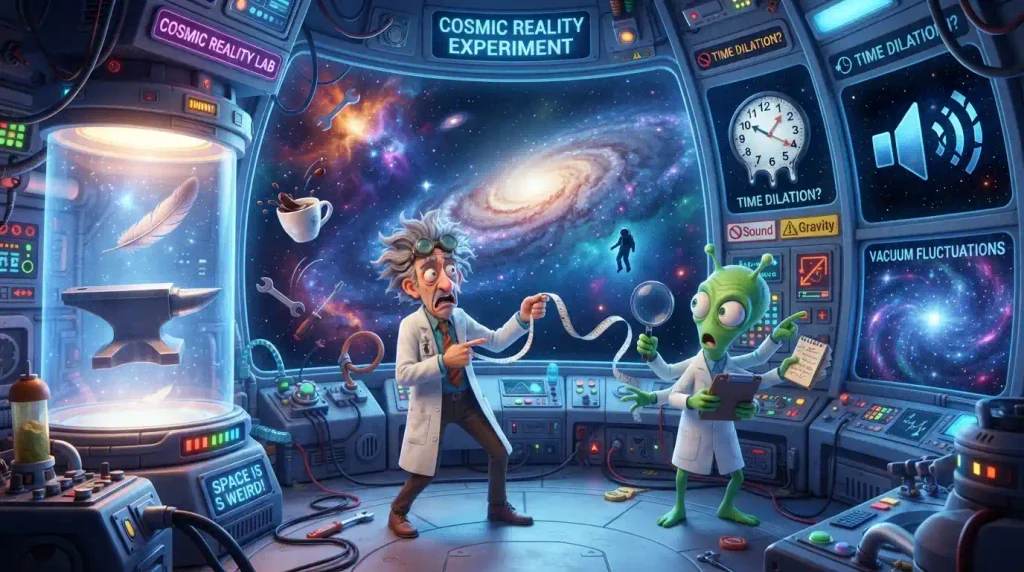
Before we look at distant stars, let us clear up what space actually feels and looks like. Most people think space is just empty dark air, but it is actually a vacuum with mind-bending properties.
Absolute Silence in the Void
Sound needs a material medium, like air or water, to travel through by pushing molecules back and forth. Because space is an almost perfect vacuum with no air, sound waves cannot travel at all. That means even if a star explodes right next to you, you would not hear a single peep. Astronauts communicate using radio waves instead, which travel through space just fine.
Extreme Temperatures
Space does not have an atmosphere to trap heat like Earth does, creating wild temperature swings. If you stand in direct sunlight near Earth, temperatures can soar past 250 degrees Fahrenheit. Step into the shadows, and temperatures drop instantly to around minus 250 degrees Fahrenheit. Your spacesuit works like an extreme thermos just to keep your body at a normal temperature.
The Invisible Force of Microgravity
Microgravity is the condition in which people or objects appear to be weightless. Astronauts float not because there is zero gravity, but because they are in a constant state of free fall around Earth. This unique floating environment changes how liquids behave, causing water droplets to form perfect floating spheres.
Mind-Blowing Planetary Anomalies
Our solar system is packed with eight official planets, each with its own weird personality. Some of these worlds experience weather so intense that it defies everyday earthly logic.
Raining Diamonds on Giant Worlds
Deep inside gas giants like Neptune and Uranus, temperatures and pressures are ridiculously high. Scientists believe these intense conditions split atmospheric methane gas into hydrogen and carbon atoms. The free carbon atoms squeeze together under intense pressure, crystallizing into real diamonds that drift down through the planet’s atmosphere like solid sparkling raindrops.
A Volcano Bigger Than Everest
Mars is home to Olympus Mons, the largest volcano ever discovered in our solar system. It is a shield volcano that stands an unbelievable 13 miles tall, making it about three times taller than Mount Everest. Because the Martian crust does not move like Earth’s tectonic plates, the volcano stayed over a volcanic hotspot for millions of years, growing continuously larger.
Venus Rotates Backwards
Most planets in our solar system spin in the same counter-clockwise direction. Venus, however, spins clockwise on its axis in a direction known as retrograde rotation. To make things even stranger, Venus spins so slowly that one single day there lasts longer than a full Venusian year. A day on Venus takes 243 Earth days, while its orbit around the Sun takes only 225 Earth days.
Floating Wonders Beyond Earth
Space is not just full of planets; it contains massive structures that dwarf everything we see on Earth. When you look deeper into the galaxy, things get even stranger.
A Giant Reservoir of Cosmic Water
Astronomers found a massive cloud of floating water vapor sitting 12 billion light-years away from us. This giant reservoir holds more than 140 trillion times all the water found in Earth’s oceans combined. It surrounds a supermassive black hole called a quasar, feeding the black hole while spewing out enormous amounts of energy.
The Mystery of Floating Asteroids
Asteroids are leftover materials from the formation of our solar system roughly 4.6 billion years ago. Most of them sit in a massive belt located right between Mars and Jupiter. Some asteroids are tiny pebbles, while others are so big they earn the title of dwarf planet. Despite what movie scenes show, asteroids in the main belt are usually millions of miles apart from one another.
Rogue Planets Wandering in Darkness
Not all planets orbit a star; some wander through deep space completely alone. Known as rogue planets, these untethered worlds were ejected from their original solar systems by gravitational chaos. Millions of these dark, cold worlds drift through the Milky Way without ever seeing a sunrise.
Solar System Data Overview
The Solar System is a fascinating cosmic neighborhood filled with planets, moons, asteroids, and comets. Its members vary greatly in size, temperature, and composition.
Planetary Diversity
Eight planets have unique characteristics and environments.
Distance From the Sun
Planets orbit the Sun at different distances.
Cosmic Objects
Moons, asteroids, and comets add incredible variety.
Wild Secrets of Stars and Suns
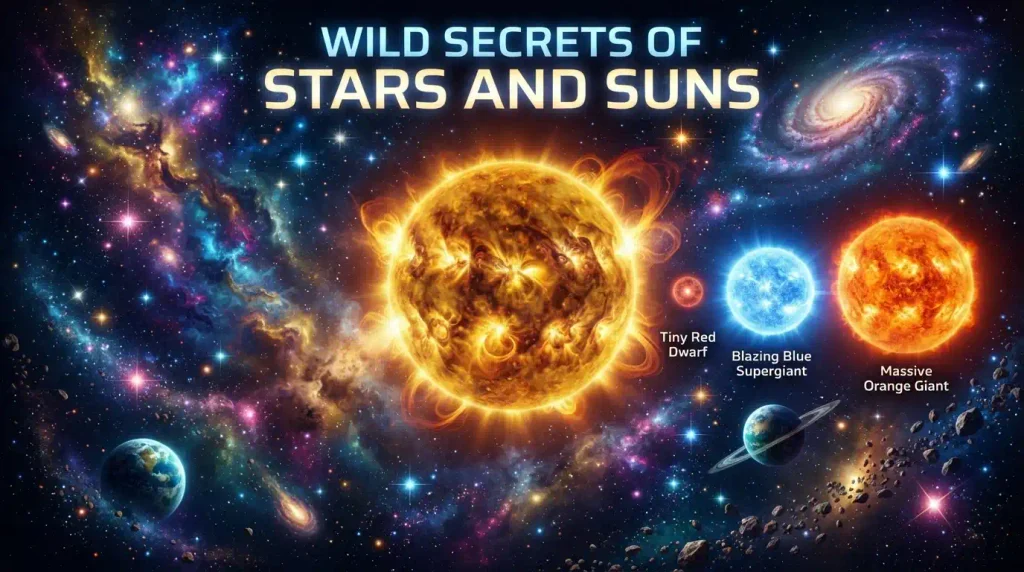
Our Sun powers all life on Earth, but stars come in many different shapes, ages, and sizes. Understanding fun facts space reveals about stars helps us appreciate how rare Earth really is.
A Sun So Huge It Boggles the Mind
The Sun accounts for nearly 99.86 percent of all the total mass in our solar system. You could pack roughly 1.3 million Earths inside the Sun if it were a hollow plastic ball. Even though it seems massive to us, the Sun is actually a medium-sized star known as a yellow dwarf. Giant stars like UY Scuti are so huge they could hold over five billion Suns!
Neutron Stars Are Unbelievably Dense
When a massive star runs out of nuclear fuel, it can collapse into a tiny, hyper-dense ball called a neutron star. These objects pack the mass of about two Suns into a city-sized sphere only 12 miles wide. A single sugar-cube-sized piece of neutron star material would weigh around 6 billion tons on Earth—roughly equal to Mount Everest!
Star Explosions Create Essential Elements
When massive stars reach the end of their lives, they explode in violent events called supernovas. These blasts generate such intense heat that they create heavy elements like gold, silver, and iron. Almost all the heavy elements in your body and on Earth were forged inside the bellies of ancient dying stars.
The Strange Physics of Black Holes
Nothing captures our imagination quite like black holes. They are regions where gravity pulls so hard that not even light can break free.
Time Slows Down Near Gravity Wells
According to Albert Einstein’s theories, massive gravitational fields slow down the passage of local time. If you stood near the edge of a massive black hole, your watch would tick much slower than a friend’s watch back on Earth. This effect is called gravitational time dilation, and it is a real phenomenon measured every day.
Spaghettification Is a Real Scientific Term
If you stepped too close to a small black hole, the gravity at your feet would be much stronger than at your head. This intense difference in force stretches your body out long and thin. Scientists literally call this process “spaghettification,” serving as a spooky reminder of extreme cosmic forces.
Supermassive Black Holes Rule Galaxies
At the center of almost every large galaxy sits a supermassive black hole weighing millions or billions of Suns. Our Milky Way has one named Sagittarius A*, which acts as an anchor pulling stars into orbital dances around the cosmic center.
Weird Phenomena in Deep Space
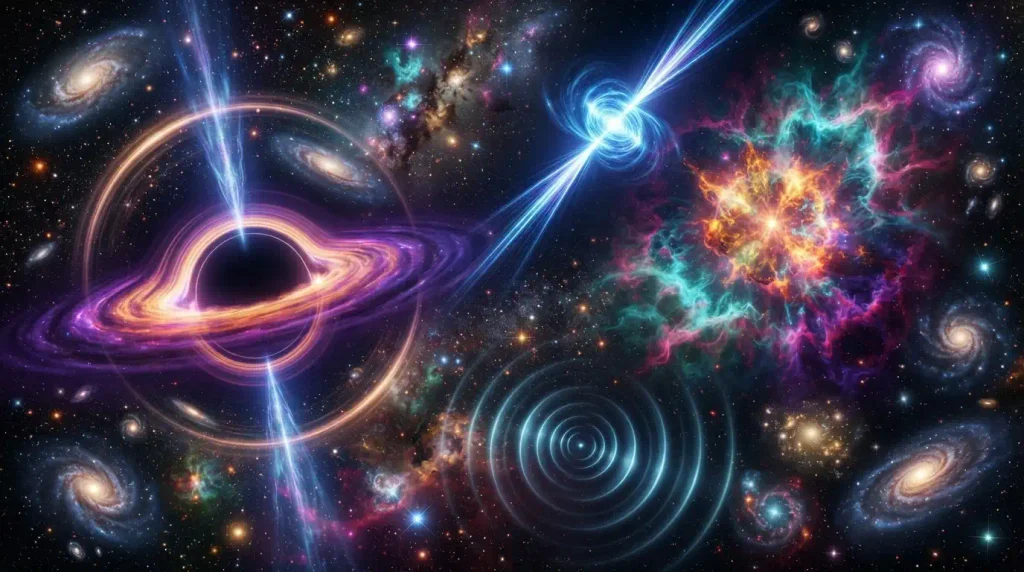
When we look past our local stars, space displays even stranger behaviors that challenge what we know about physics.
Galaxies Are Flying Apart
The universe is expanding every second, pushing galaxies further away from each other over time. Scientists discovered that this cosmic expansion is actually speeding up, driven by a mysterious force called dark energy. Eventually, distant galaxies will be so far away that their light will no longer reach night skies on Earth.
Dark Matter Takes Up Most Space
Everything we can touch, see, and measure—stars, planets, gas clouds, and humans—makes up only 5 percent of the universe. The rest is invisible material known as dark matter and dark energy. We know dark matter exists because its heavy gravitational pull bends light and keeps fast-rotating galaxies intact.
Cosmic Collisions Are Common
Galaxies do not just drift; they frequently collide and merge with one another over billions of years. Our Milky Way is currently on a collision course with the neighboring Andromeda galaxy. Because space is mostly empty, individual stars rarely crash during these colossal galaxy mergers.
How Space Travel Changes the Human Body
Human bodies evolved to live in Earth’s protective environment and comfortable gravity. When astronauts go into space, strange physical changes start happening right away.
Astronauts Grow Taller in Microgravity
Without Earth’s gravity pushing down on your body, your spinal column stretches out. Astronauts spending months on the International Space Station can grow up to two inches taller while in orbit. However, once they return to Earth, gravity pushes their spine back down to its original height.
Space Motion Sickness Is Common
When you enter microgravity, your inner ear floating fluids get confused because there is no clear “up” or “down.” This causes space motion sickness, leaving many astronauts dizzy for their first few days. Their bodies also shift fluids upward, giving astronauts puffy faces and skinny legs while in orbit.
Loss of Bone and Muscle Density
In microgravity, muscles and bones do not have to work against gravity to support your weight. As a result, astronauts lose muscle mass and bone density rapidly if they do not exercise daily. Spacefarers use special resistance equipment to stay fit and healthy during long space missions.
Strange Space Weather Events
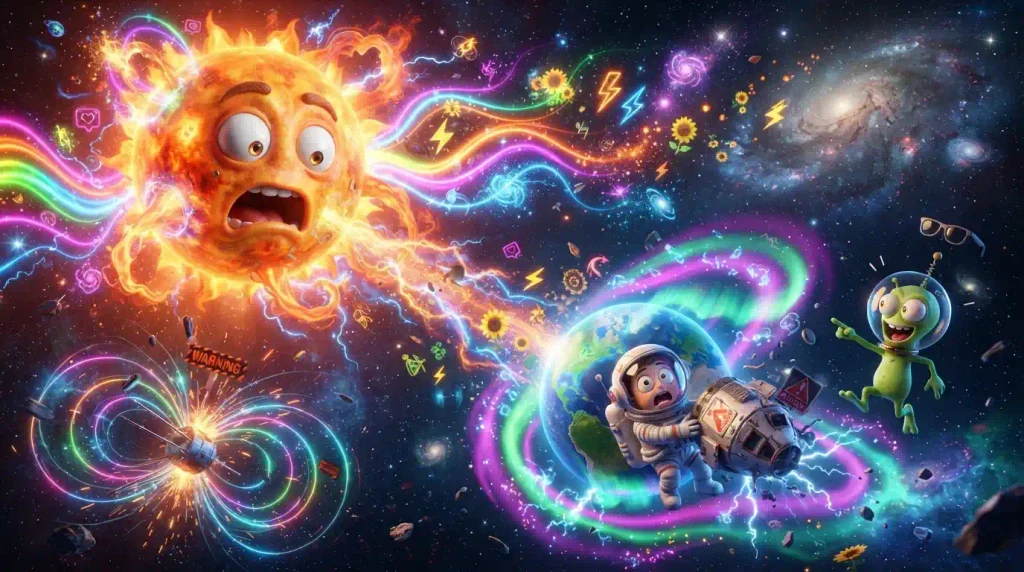
Weather on Earth means rain, snow, and wind, but space weather involves radiation storms, magnetic fields, and intense solar winds.
Solar Flares Release Massive Energy
The Sun regularly shoots off massive bursts of radiation called solar flares, along with solar plasma blasts. These energetic events send streams of high-energy particles zooming through our solar system at millions of miles per hour, occasionally disturbing satellites and power grids.
Cosmic Rays Pass Right Through You
Deep space is filled with invisible high-energy particles called cosmic rays coming from dying stars and distant galaxies. These super-fast particles pass right through objects, including spacecraft walls and human bodies. Astronauts often report seeing tiny light flashes in their eyes when closed, caused by cosmic rays.
Auroras Light Up Polar Skies
When solar particles hit Earth’s magnetic field, they are funneled toward the magnetic poles. There, they collide with gases in our atmosphere like oxygen and nitrogen. This collision releases energy in the form of glowing green, purple, and red lights known as auroras.
Practice Exercise
- Why is space completely silent?
A. Space absorbs sound waves automatically.
B. There is no air or medium for sound waves to travel through.
C. Stars produce counter-noise that cancels sound out.
D. Planets absorb all sound vibrations with gravity. - What material falls like rain on gas planets like Neptune and Uranus?
A. Gold
B. Frozen nitrogen
C. Liquid iron
D. Diamonds - How tall is the Martian volcano Olympus Mons compared to Mount Everest?
A. Twice as tall
B. About three times as tall
C. Half the height
D. Ten times as tall - Which planet spins in a clockwise direction on its axis?
A. Mars
B. Jupiter
C. Venus
D. Mercury - How much of the solar system’s total mass is contained in the Sun?
A. 50%
B. 75%
C. 99.86%
D. 90% - What happens to the human spine in microgravity?
A. It shrinks
B. It expands, making astronauts taller
C. It twists to the left
D. It stays the same - What is the process of stretching near a black hole called?
A. Noodling
B. Spaghettification
C. Compression
D. Gravitational snap - How much of the universe is made of normal, visible matter?
A. Around 5%
B. Around 50%
C. Around 85%
D. 100% - What natural event creates the Northern Lights on Earth?
A. Moon reflections
B. Solar particles colliding with Earth’s magnetic field
C. Burning meteor showers
D. Starlight refracting through clouds - Why do day and night temperatures swing drastically in open space?
A. There is no atmosphere to trap heat
B. Space moves closer to the Sun at night
C. Cosmic rays absorb heat
D. Stars turn off periodically
Answer Key
1. B | 2. D | 3. B | 4. C | 5. C | 6. B | 7. B | 8. A | 9. B | 10. A
FAQs
1. What are some of the most surprising fun facts space has revealed?
Space has revealed that diamonds rain down on giant planets like Neptune, silent vacuums stop all sound, and massive water clouds float light-years away. These discovery milestones show how active, dynamic, and downright bizarre our wider cosmic environment really is.
2. Can you hear any sound at all while traveling in space?
You cannot hear sounds outside your space vehicle because sound waves require matter like air to travel. Inside a pressurized space station or suit, you hear normal sounds because enclosed air molecules carry the vibrations directly to your ears.
3. How cold does it get in deep outer space?
Deep space stays extremely cold, averaging around minus 455 degrees Fahrenheit, just above absolute zero. Without a nearby star emitting heat radiation, matter rapidly loses warmth into the surrounding cosmic void.
4. Is it true that the Sun will run out of fuel eventually?
Yes, the Sun burns through its hydrogen fuel supply over billions of years. In about five billion years, it will expand into a red giant, shed its outer layers, and leave behind a cooling stellar remnant called a white dwarf.
5. Why do stars twinkle when we look at them from Earth?
Stars twinkle because their light passes through Earth’s moving, churning atmospheric layers before reaching your eyes. This shifting air refracts starlight continuously, making distant stars appear to shimmer and change brightness.
6. Are black holes dangerous to Earth right now?
No, there are no black holes close enough to our solar system to pose any danger to Earth. Gravity from a black hole only affects objects that get extremely close to its event horizon boundary.
Conclusion
Fun facts about space make learning about the universe exciting and enjoyable. From enormous galaxies and glowing stars to mysterious black holes and fascinating planets, space is filled with incredible discoveries that continue to amaze scientists and curious minds.
Exploring fun facts about space helps us understand how planets, stars, moons, and galaxies exist and interact across the universe. These fascinating details also show how much we have discovered about space and how many mysteries are still waiting to be explored.
Whether you love astronomy or simply enjoy learning something new, fun facts about space offer an exciting journey beyond Earth. The universe is vast, mysterious, and constantly changing, making space one of the most fascinating subjects for discovery and exploration.

Zoey Carter is the creator and writer behind funsvibe.com, a friendly website where readers can discover interesting, entertaining, and useful content. She enjoys exploring different topics and turning fresh ideas into simple, engaging articles that are easy to understand. Zoey believes that good content should be informative while still feeling natural and enjoyable to read.
Through funsvibe.com, Zoey Carter focuses on sharing original, reader friendly content with a warm and conversational style. She enjoys researching new subjects, discovering helpful information, and presenting ideas in a clear way. Her goal is to make every visit enjoyable while giving readers something valuable to discover and remember.